Please View Sponsored Advertisements to Support this Site and Project
ARTICLES
1.Arsenic: Growing menace
2. Ravages of arsenic poisoning
3. Arsenic Threat
4. A market basket survey of inorganic arsenic in food.
5. Hydrogeological investigation of ground water arsenic contamination in south Calcutta.
6. SEARCHING FOR SOLUTIONS
7. ARSENIC REVISITED
8. WATER POLLUTION IN THE GANGES BRAHMAPUTRA DELTA PLAIN
9. The Independent 31st May 2000 Arsenic poisoning: man-made disaster? by Almas Zakiuddin
10. PANIC IN NILPHAMARA , North Bengal
11. 131 villages hit by arsenic ground water (India)
12. EXTINCTION OF BIODIVERSITY IN BANGLADESH
13. Media workshop told 24 m people at risk of arsenic contamination
14. What price green revolution?
15. 81 pc Bhanga HTW's arsenic affected, Faridpur workshop reveals
16. US assures of support in fighting the silent havoc
17. The Curse of Pollution
18. News
19. BBC- Arsenic, Tuesday 9 May 2006 9:30-9:45 (Radio 4 FM)
20. Bacteria solution to groundwater arsenic
21. French researchers may have solution to water-born arsenic
22. Arsenic risk high in Sumatra, Myanmar, Cambodia
23. Arsenic victims Vs the British geological survey
 |
 |
 |
 Arsenic in groundwater is no longer a localised problem. The latest
survey has confirmed the worst fears in this regard by listing arsenic
contamination in Bangladesh to be the biggest in the world. However,
well-coordination action with the right sense of urgency, instead of
panic, is called for in coping with this newly unfolding gigantic problem.The
survey was done by the School of Environmental Studies (SOES) of Jadavpur
University, Calcutta, in collaboration with the Dhaka Community Hospital.
Arsenic in groundwater is no longer a localised problem. The latest
survey has confirmed the worst fears in this regard by listing arsenic
contamination in Bangladesh to be the biggest in the world. However,
well-coordination action with the right sense of urgency, instead of
panic, is called for in coping with this newly unfolding gigantic problem.The
survey was done by the School of Environmental Studies (SOES) of Jadavpur
University, Calcutta, in collaboration with the Dhaka Community Hospital.
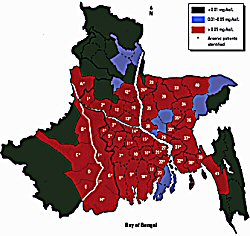
It took four and a half years to conclude; and analysed 22,003 hand
tubewell water samples from 64 districts and examined about 18,000 people,
revealing that in 54 of the country's 64 districts arsenic in ground
water is above the normal level and in 47 districts the presence of
arsenic is at a dangerous level. The level of contamination is lessened
at greater depth. The country became aware of arsenic contamination
of groundwater only in the "Nineties after use of tubewell water
for drinking in the villages was universalised. Experts say that the
cause is geological.
We further understand that no technology is yet
available to rid or reduce groundwater arsenic at source, but there
are various methods to control arsenic at user level and some of these
methods are inexpensive too. The magnitude of the problem being what
it is, the government will not be able to cope with the problem on its
own. International cooperation should be extended to deal with this
humanitarian issue.
There may not be any omnibus answer to arsenic and
different regions may call for different actions. For example, in some
severe cases the tubewell may have to be sealed, in other cases filter
media' may work; in some affected areas water from dug well may be found
arsenic-free and may be recommended for drinking after boiling.As we
anticipate, some business firms may come out with ready-made solutions
from motives of quick profit, and market things like filter jars', etc.
In that case the authorities ought to ensure that the claims are scientifically
sound and not just a bluff. We say this because in this country the
relevant laws are lax.
Source: The Independent, 7 May 2000
 Presence of high concentration of arsenic in drinking water in excess
of acceptable limit has become a major concern in Bangladesh. A number
of government agencies and NGOs have been conducting testing of tubewell
water for detecting the presence of arsenic. According to WHO report,
groundwater of 41 districts of Bangladesh has been affected by arsenic
contamination. Based on information from the DPHE UNICEF national testing
programme, 29 per cent tubewells across the country contain arsenic above
the maximum permissible level (>0.05mg/L).
Presence of high concentration of arsenic in drinking water in excess
of acceptable limit has become a major concern in Bangladesh. A number
of government agencies and NGOs have been conducting testing of tubewell
water for detecting the presence of arsenic. According to WHO report,
groundwater of 41 districts of Bangladesh has been affected by arsenic
contamination. Based on information from the DPHE UNICEF national testing
programme, 29 per cent tubewells across the country contain arsenic above
the maximum permissible level (>0.05mg/L).
About 40 million of people
are at risk of arsenic contamination in which 7000 (approx.) people are
already arsenic-affected.Arsenic in drinking water is a new hazard in
Bangladesh and is an extremely complex problem. Much is yet to know regarding
its real risk to human life. It is well known that arsenic in any form
is toxic when absorbed in human body beyond the tolerable level. Arsenic
poisoning is causing serious health hazards to the affected persons, and
at the same time it is creating a lot of socio economic problems. But
overall awareness is very low.
The situation has given rise to misinterpretation
and misconception due to lack of awareness even in the educated circles.
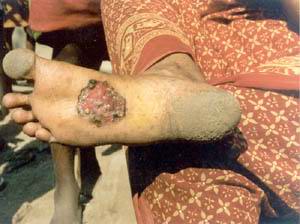
Due to our ignorance, some people are mistaking skin disorders resulting
from arsenosis for leprosy or other contagious diseases. Victims are not
allowed to attend any social and religious functions. Sometimes affected
children are prevented from attending schools. Affected families are refused
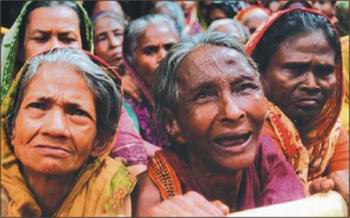
to take water from the neighbours' tubewells. The women are the worst
sufferers because they are more malnourished than men, so are less able
to deal with arsenic that invades their bodies.
This has resulted in a
lack of understanding in men and as a result many have divorced their
wives. Sometimes, husbands' families are not agreed to take meal from
affected women. It does not end there for girls who succumb to the poison.
They are finally not accepted as wives. Of course it can work the other
way round too, and a man with arsenicosis may not be able to find a bride
or he and his family is ostracised.
In some cases affected young unmarried
women and men are advised to remain unmarried. Even victims are denied
to get jobs. Arsenic disease is more prevalent amongst the poor people.
These victims become incapable of giving hard labour and getting curative
measures, and therefore, face a distressed future in the vicious cycle
of increasing poverty and ill health.
Further, this is compounded by negative
social attitudes. Unfortunately victims are sometimes treated as untouchable
and as if they had an infectious disease.There is no end to the pain.
In other words, to be poisoned by arsenic is not only a death sentence
but a tragedy for the families too. It is also a tragedy for the nation,
especially if men are victims, for it also harms the development efforts
of the nation as victims are incapable of contributing to the country's
economic growth. Such is the debilitating nature of the disease. On the
other hand, there are people who see arsenic contamination of the groundwater
as a means and an opportunity to make money.
A few case studies reported
by Dhaka Community Hospital pointed to the magnitude of arsenic problem
and its social effects. A college-going young man of Khoksha in Kushtia
has spent about Tk. 40,000 to cure his skin ailments, but the treatment
had no results. After he was identified as an arsenic patient, he just
looked dazed in shock and despair. A young village woman of 21 years in
Noakhali has experienced a lot already in life. She was divorced soon
after her marriage because arsenic poisoning caused nasty scars on her
skin. She has lost her zest for life. Even her parents now wish death
to their beloved daughter.
There are many more such stories in the arsenic-affected
areas.Avoiding arsenic contaminated water can alleviate the arsenic calamity.
The way to avoid arsenic poisoning is to avoid intake of both arsenic
contaminated food and drink. The people of the affected areas can drink
surface water after its filtering and boiling. Various technologies are
under consideration to reduce arsenic content below safe limits. But yet
there is no foolproof solution to treating and obtaining cost effective
arsenic-free water, particularly within the reach of the poor. In this
regard social awareness building can play an important role in the safety
of our health.
The conscious family and society must come forward first
to take cue from the poor victims. Sufferers must get proper care and
education. Government, donor agencies, private organisations, NGOs, educational
institutions, press etc should jointly come forward to help mitigate the
arsenic problem in Bangladesh. Health professionals like doctors, toxicologists,
pharmacists, paramedics, nurses and radio, television can play key role
in creating public awareness.
Source: The Independent, 4 March 2000
3. Arsenic Threat
 A LEAST developed country like Bangladesh, saddled as it is with numerous
problems, has been burdened with another and quite a formidable one because
it involves drinking water that is basic to life and living. Arsenic presence
in underground water - used heavily in Bangladesh for drinking and all
household activities - was detected some six or seven years ago. The problem
then was thought to be limited to certain areas but later this notion
was proved wrong. Subsequent investigations and reports disclosed more
and more areas to be under arsenic contamination. High percentages of
arsenic contamination in ground water have been detected in so many places
that practically the menace now extends in varying degrees to nearly all
of the country. According to the latest research, nearly 70 million people
out of the country's about 130 million people - meaning more than one
half of the entire population - fall in the arsenic risk zones. This is
a deeply worrying figure to say the least.
A LEAST developed country like Bangladesh, saddled as it is with numerous
problems, has been burdened with another and quite a formidable one because
it involves drinking water that is basic to life and living. Arsenic presence
in underground water - used heavily in Bangladesh for drinking and all
household activities - was detected some six or seven years ago. The problem
then was thought to be limited to certain areas but later this notion
was proved wrong. Subsequent investigations and reports disclosed more
and more areas to be under arsenic contamination. High percentages of
arsenic contamination in ground water have been detected in so many places
that practically the menace now extends in varying degrees to nearly all
of the country. According to the latest research, nearly 70 million people
out of the country's about 130 million people - meaning more than one
half of the entire population - fall in the arsenic risk zones. This is
a deeply worrying figure to say the least.
Arsenic's effect on health does not show up readily. People in the affected
areas have been drinking such contaminated water for years together not
suspecting the effects of the same on their health. The tell-tale lesions
on the skin and other physical dysfuntions from long-term exposure to
arsenic start showing up only after some years. Therefore, the menace
has been quietly creeping up on people when its victims remained rather
in the dark about it.
The latest findings pointing to the extent of the health hazard posed
by arsenic in water leave no room for complacence. The government must
act quickly and decisively to counter this very serious health problem
with the seriousness it deserves. Human lives not in hundreds of thousands
but millions are now involved and no administration worth its name can
remain a silent spectator to such a dangerous threat to health that engulfs
the population. Unfortunately, the government's reactions so far have
been mainly limited to awareness building and very limited attempts to
provide some safeguards. However, these actions are surely too inadequate
and meaningless when extensive programmes need to be started in the affected
areas to provide the means of using relatively arsenic free-water.
One may say that this is easier said than done. But the reality is that technologies
are available and the costs of the same are not prohibitive that people
on their own will not want to use them; people fearing for their lives
are found willing to even exceptionally spend money to steer clear of
danger. Why then the authorities are dilly-dallying to make available
filtration devices that can immediately provide safety against arsenic
is a question worth asking. Such devices are being used widely in even
parts of neighbouring India where arsenic is a similar public health issue.
Government bodies should not only distribute these devices extensively
throughout the country but also try to do the same at subsidised costs
to ensure that a device reaches every affected household in keeping with
the government's commitment and budgetary provisions of safeguarding people's
health. Besides, several natural processes are also available that can
substantially filter arsenic from water. The devices and the processes
need to be immediately introduced in affected areas under crash programmes.
The official thinking perhaps is that even cheaper technologies and processes
will be devised and then the campaign against arsenic can start in right
earnest. This is a suicidal thinking because human lives cannot be left
to high risks for the rationale of applying cheaper technologies.
Meanwhile, there is also the very pressing need to go all out for harvesting
rain water. Rain water is the freshest natural form of water available
and many countries round the world harvest rain water in great quantities
to meet the needs of their population. The use of rain water in Bangladesh
is still very limited although it can go some way in providing relief
from arsenic contamination. Rain water in good amounts can be harvested
throughout the greater part of the year in Bangladesh when rainfall is
found to be frequent. Together with rain water, use of surface water of
rivers and water bodies - treated for impurities - will have to be considered
to face up to the arsenic threat.
Source: The Financial Express, 4 March 2000
4. A market basket survey of inorganic arsenic in food
Schoof, R., L. Yost, et al. Food Chem Toxicol 37(8): 839-46. Dietary arsenic intake estimates based on surveys of total arsenic concentrations
appear to be dominated by intake of the relatively non-toxic, organic
arsenic forms found in seafood. Concentrations of inorganic arsenic in
food have not been not well characterized. Accurate dietary intake estimates
for inorganic arsenic are needed to support studies of arsenic's status
as an essential nutrient, and to establish background levels of exposure
to inorganic arsenic. In the market basket survey reported here, 40 commodities
anticipated to provide at least 90% of dietary inorganic arsenic intake
were identified. Four samples of each commodity were collected. Total
arsenic was analysed using an NaOH digestion and inductively coupled plasma-mass
spectrometry. Separate aliquots were analysed for arsenic species using
an HCl digestion and hydride atomic absorption spectroscopy. Consistent
with earlier studies, total arsenic concentrations (all concentrations
reported as elemental arsenic per tissue wet weight) were highest in the
seafoods sampled (ranging from 160 ng/g in freshwater fish to 2360 ng/g
in saltwater fish). In contrast, average inorganic arsenic in seafood
ranged from less than 1 ng/g to 2 ng/g. The highest inorganic arsenic
values were found in raw rice (74 ng/g), followed by flour (11 ng/g),
grape juice (9 ng/g) and cooked spinach (6 ng/g). Thus, grains and produce
are expected to be significant contributors to dietary inorganic arsenic
intake.
Dietary arsenic intake estimates based on surveys of total arsenic concentrations
appear to be dominated by intake of the relatively non-toxic, organic
arsenic forms found in seafood. Concentrations of inorganic arsenic in
food have not been not well characterized. Accurate dietary intake estimates
for inorganic arsenic are needed to support studies of arsenic's status
as an essential nutrient, and to establish background levels of exposure
to inorganic arsenic. In the market basket survey reported here, 40 commodities
anticipated to provide at least 90% of dietary inorganic arsenic intake
were identified. Four samples of each commodity were collected. Total
arsenic was analysed using an NaOH digestion and inductively coupled plasma-mass
spectrometry. Separate aliquots were analysed for arsenic species using
an HCl digestion and hydride atomic absorption spectroscopy. Consistent
with earlier studies, total arsenic concentrations (all concentrations
reported as elemental arsenic per tissue wet weight) were highest in the
seafoods sampled (ranging from 160 ng/g in freshwater fish to 2360 ng/g
in saltwater fish). In contrast, average inorganic arsenic in seafood
ranged from less than 1 ng/g to 2 ng/g. The highest inorganic arsenic
values were found in raw rice (74 ng/g), followed by flour (11 ng/g),
grape juice (9 ng/g) and cooked spinach (6 ng/g). Thus, grains and produce
are expected to be significant contributors to dietary inorganic arsenic
intake.
Typical clinical symptoms of acute arsenic poisoning have been detected in 1000 residents near a factory in P.N. Mitra Lane, Behala, South Calcutta, located in a thickly populated area manufacturing copper acetoarsenite (Paris-Green) an arsenical pesticide for the past 25 years. Soil around the effluent dumping point of the factory was exceptionally contaminated, with arsenic, copper and chromium concentrations of 20,100-35,500 mg kg-1, 33,900-51,100 mg kg-1 and 5300- 5510 mg kg-1. Arsenic and copper concentrations in bore-hole soils collected up to a depth of 24.4 m at the effluent dumping point, decreased with depth. Arsenous acid, arsenic acid, methylarsonic acid (MA) and dimethylarsinic acid (DMA) were detected in bore-hole soils up to a depth of 1.37 m, after which only inorganic arsenical compounds were present. A positive correlation was established between arsenic and copper authenticated the Paris-Green waste disposal site as the source of contamination.
Mechanism of ground water contamination from this disposal site had been probed by a systematic hydrogeological survey and the arsenic content of the tube-well waters in the surrounding areas. Hydraulic conductivity was maximum in the central part. The site for disposal of the effluent was a ditch located in the zone of discharge. Sparingly soluble Paris-Green cumulatively deposited in the waste disposal site is decomposed by micro-organisms to water- soluble forms and finally percolated to underground aquifers along with rain water through the discharge zone. The contaminant is currently moving towards WNW with ground water flow and the residents in the direction of encroaching contamination are insecure due to penetration of the contaminant
Introduction
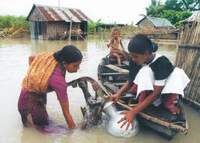 In Bangladesh today, more than 90 per cent of the population get their
drinking water from the million plus tube-wells that were installed for
the anti-diarrhoeal campaign. This was one of the few success stories
in the public health sector for it helped reduce water-borne diseases.
But tubewells are now dispensing arsenic-laced water, with the result
that many people are showing arsenical skin lesions in the late stages
of manifestation of arsenic toxicity. This came as a shock for no one
was prepared for what could be a disaster - arsenic contamination. The
source of arsenic is believed to be geological and most water samples
show a mixture of arsenic and arsenate. None showed any methylarsonic
or dimethylarsenic acid.
In Bangladesh today, more than 90 per cent of the population get their
drinking water from the million plus tube-wells that were installed for
the anti-diarrhoeal campaign. This was one of the few success stories
in the public health sector for it helped reduce water-borne diseases.
But tubewells are now dispensing arsenic-laced water, with the result
that many people are showing arsenical skin lesions in the late stages
of manifestation of arsenic toxicity. This came as a shock for no one
was prepared for what could be a disaster - arsenic contamination. The
source of arsenic is believed to be geological and most water samples
show a mixture of arsenic and arsenate. None showed any methylarsonic
or dimethylarsenic acid.
Water is one of the major means of transport of arsenic in the environment.
Arsenic in the aquatic environment is predominant in places with high
geo-thermal activity. Soil erosion and agricultural run-offs are also
large contributors to the arsenic concentration in sediments. High arsenic
levels have been reported to be associated with sediments and a potential
exists that it may be released in hazardous amounts to the overlying waters.
Industrial effluents are also a major source of arsenic to the environment.
Arsenic and arsenical compounds are found in effluent from metallurgical
industry; glassware and ceramic industry; dye and pesticide manufacturing
industry; petroleum refining; rare earth industry and other organic and
inorganic chemical industries. It finds an application in the manufacture
of herbicides and pesticides. Other industries using arsenic include wood
and hide preservatives; lead shot manufacture; phosphate detergent builder;
and pre-soaks used in many fertilisers.
A chemical factory manufacturing
several chemicals including the insecticide Paris-Green (acetocopper arsenic)
was responsible for the contamination of wells in the southern part of
Calcutta, India. Over 7000 people were consuming the arsenic contaminated
water for several years but this fact remained unnoticed until September
1989. A few died and some of the victims were hospitalised while symptoms
of arsenic poisoning were evident in many families living in the area.
As arsenic is a cause for skin, liver, lung and kidney or bladder cancer,
it is a big headache for the nation. Due to this carcinogenicity of some
arsenic compounds, the objective should now be to reduce exposure to arsenic
contaminated water to a level as close to zero as possible, taking into
consideration its health effects and toxicology, occurrence and human
exposure, availability and cost of treatment technology, the practical
quantitation limit of arsenic normally found in drinking water.
Addressing the problem
Various treatment methods have been adopted to remove arsenic from drinking
water under both laboratory and field conditions. The major mode of removing
arsenic from water by physical-chemical treatment methods. Various treatment
methods include:
adsorption-co-precipitation using iron and aluminium salts adsorption on activated alumina/activated carbon/activated bauxite reverse osmosis ion exchange oxidation followed by filtration
Scientists and health and water experts have intensified their search for treatment methodologies and reliable alternative sources of water supply. The United States Environmental Protection Agency (USEPA) have summarised coagulation with iron and aluminium salts and lime softening as the most effective treatment process for removing arsenic from water to meet the interim primary drinking water regulations standard of 0.05 mg/L [30]. That regulatory agencies are reviewing maximum allowable concentration levels in drinking water is comforting but, as arsenic contamination of ground water and the possibility of poisoning is too alarming to wait for solutions, it is essential to locate alternative sources.
The most logical answer would be to go back to using surface water sources. But as most of these sources are heavily polluted with bacteria, some simple method of disinfection is required. Boiling is an effective method of disinfection but, in Bangladesh, poverty, the difficulty with which fuel can be obtained as well as the current rate of illiteracy, prevents people from boiling water.
Solar decontamination
One alternative may possibly be solar decontamination. During the eighties, Professor Acra and his colleagues at the University of Beirut demonstrated how a wide range of microbes, including pathogenic bacteria and viruses, can be inactivated by exposing the contaminated water to sunlight. The process that was adopted was simple. All that was needed to make the contaminated water drinkable was to place the water inside a transparent glass container or a transparent plastic container and place it in the direct sunlight for two to three hours before drinking.
Although some doubt has been cast on the effectiveness of solar disinfection, the anti-microbial properties of sunlight have been known for a long time but it is only recently that solar radiation has been seriously proposed as a means for decontaminating water. All that is really needed is a reasonably constant and reliable source of sunlight. Several researchers have successfully demonstrated that sunlight will destroy much of the faecal bacteria present in contaminated drinking water but this process is especially effective if the water contains a sufficient amount of oxygen. An easy way to ensure this is to oxygenate the water before hand by mixing it with air.
That sufficient oxygen is needed to be effective has also been confirmed by other researchers in the UK who have shown that the effectiveness of solar decontamination of water is strongly dependent upon its oxygen status. Under controlled conditions, tests using water contaminated with either pure cultures of faecal bacteria, freshly voided faeces or raw sewage, were exposed to full strength, natural sunlight for several hours causing a substantial decrease in the bacterial count when the water was fully oxygenated. De-oxygenated water gave a far slower rate of decrease.
This means that over a period of several hours, sunlight and oxygen can act together to inactivate faecal bacteria. But the most significant practical aspect of this kind of solar "photo-oxidative" disinfection is that the oxygen level of the water must be kept close to maximum value during the exposure of water to full strength sunlight. Simple experiments undertaken by the team showed that a clear plastic or glass bottle, three-quarters filled with de-oxygenated water and capped, shaken vigorously for a couple of minutes will create air bubbles which will restore the oxygen level of the water to near saturation point. As microbes present in the water may consume the dissolved oxygen, this will reduce the effectiveness of this disinfection process. Therefore it is essential to shake each bottle a few times during the period of exposure to sunlight to ensure the oxygen level is kept close to maximum.
If the above routine can be followed to the letter, solar photo-oxidative disinfection will give consistently effective results provided the bottles are illuminated by sunlight of a sufficient intensity to give clearly defined shadows. Professor Acra's pioneering work has shown that the most favourable solar conditions are obtained between the latitudes of 15" and 35" North and South of the equator where sunlight is both consistent and predictable. With slightly less favourable conditions such as in equatorial and tropical regions (between latitudes of 0" and 15") it may not be as effective, due to the higher cloud cover, for this process is slowed down under cloudy conditions.
Nevertheless this technology has important implications for us for small-scale water treatment. Clear glass bottles however, restrict the penetration of short-wave ultra-violet component of sunlight which may lead to a slower rate of microbial inactivation, in which case clear plastic containers may be a better option. Glass containers may. however, be more durable for as the temperature rises during illumination, some plastic bottles may leach small amounts of plasticisers. Also they have a tendency to becoming increasing opaque to short-wave-length light from any prolonged exposure to the sun.
Water turbidity and colour may reduce the rate of bacterial inactivation. Such negative effects are insignificant except when the water is highly turbid or coloured when light transmission is reduced to less than half the surface value.
Solar photo-oxidative disinfection works better if the water source is relatively clear or when turbidity or colour does not substantially restrict the penetration of sunlight. This could be a problem in time of flood when water turbidity and colour normally increase, in which case the water will need some initial processing before being placed in sunlight. This could have an advantage for a proportion of the contaminating microbes would be removed prior to solar photo-oxidation.
Solar photo-disinfection can be carried out in the home by individuals, families or small communities without any need for a significant financial investment or external agency support - (the only requirement being a sufficient number of bottles to provide enough drinking water to meet each person's daily needs). Therefore, solar water treatment might be the answer to the problem of arsenic contamination for any low-income community where the cost of engineering solutions may prove too high.
In places where there is already a water supply system, it may make greater sense to install large solar powered water purification systems which can treat large quantities of water. Ultraviolet disinfection uses an ultraviolet (UV) light source enclosed in a transparent protective sleeve, mounted in such a manner that the water that passes through the flow chamber admit the UV rays and absorb them into the stream. These rays are able to destroy bacteria and inactivate many viruses. This kind of system disinfects the water without the need for adding chemicals and as a result, possesses some of the benefits of distillation.
It neither creates new chemical complexes nor changes the taste or odor of the water - and - it does not remove any beneficial minerals that may be in the water. However if the water is partially treated by the sediment process and carbon filter prior to passing through the UV flow chamber, it is more effective. Some of the bacteria that can be rendered ineffective through this process include - Leptospira interrogans (Infective Jaundice); Salmonella paratyphi (enteric fever); Salmonella typhosa (typhoid fever) Shigella dysenterai (dysentery); Shigella Flexneri (dysentery) Vibrio cholerae; Streptococcus; Staphylococcus; Escherichia coil; Hepatitis virus; Influenza virus; Poliovirus (poliomyelitis); Rotavirus and Bacteriophage (E.col) and yeast and fungi, all common in Bangladesh.
Acknowledgements:
ITDG UK
AIT, Bangkok, Thailand
Disaster Forum, Bangladesh
Due to the more pressing problem of the flood and its aftermath, the presence of arsenic in the ground water has all but been forgotten. But this in itself spells danger for once forgotten, long-term problems of this nature are likely to be shelved until they regain their former virulence. Yet to a thinking person, it is hard to imagine how a problem as severe and serious as wholesale poisoning can be elbowed aside for any reason.
 What is especially astonishing and at the same time distressing is that
this is the worst case of mass-poisoning the world has ever known, as
such, the inability of most people to comprehend its portent is quite
remarkable especially as this topic has caught the media's attention for
some time now. The fact that inorganic arsenic has been a recognised poison
since ancient times does not help us, for the presence of arsenic in ground
water can only be viewed by this over-populated country as alarming. Yet,
judging from the lack of correspondence in the press on this subject,
few people, if any, seem unduly alarmed about something that could increasingly
become a threat to life and limb, for them and their families. Yet the
slow ingestion of arsenic over a long period of time can cause several
forms of cancer like skin, liver, lung, kidney and bladder, as well as
other diseases. Already the manifestation of arsenic-related illnesses
is becoming alarming high in some parts of the country. Apart from the
human cost, it is very likely to become an unwarranted large burden on
the already hard-pressed health services. WHO estimates the time factor
for the appearance of cancer is between ten to twenty years of exposure
and, although this may mean it is too early to detect any increase in
mortality from cancer, this factor cannot be ignored.
What is especially astonishing and at the same time distressing is that
this is the worst case of mass-poisoning the world has ever known, as
such, the inability of most people to comprehend its portent is quite
remarkable especially as this topic has caught the media's attention for
some time now. The fact that inorganic arsenic has been a recognised poison
since ancient times does not help us, for the presence of arsenic in ground
water can only be viewed by this over-populated country as alarming. Yet,
judging from the lack of correspondence in the press on this subject,
few people, if any, seem unduly alarmed about something that could increasingly
become a threat to life and limb, for them and their families. Yet the
slow ingestion of arsenic over a long period of time can cause several
forms of cancer like skin, liver, lung, kidney and bladder, as well as
other diseases. Already the manifestation of arsenic-related illnesses
is becoming alarming high in some parts of the country. Apart from the
human cost, it is very likely to become an unwarranted large burden on
the already hard-pressed health services. WHO estimates the time factor
for the appearance of cancer is between ten to twenty years of exposure
and, although this may mean it is too early to detect any increase in
mortality from cancer, this factor cannot be ignored.
As long term exposure to arsenic can lead to hyper-keratosis, conjunctivitis,
hyper-pigmentation, gangrene in the limbs as well as the cancers previously
described, allowing people to have access only to contaminated water is
inconceivable, and as arsenic is also in the food chain, the urgency must
be given the recognition it deserves. Recent research from China (September,
1998), showed that rice grown on As-polluted soil contained 0.7 mg As/kg.
Some plants such as mustard, cabbage, cauliflower etc. accumulate metals
and metalloid (like arsenic). The major portion of absorbed arsenic is
excreted through the urine (about 50 per cent); a small portion through
faeces; skin; hair; and nails, and as it can be stored by the body in
metabolically dead tissues and then slowly eliminated, some people may
be tempted to play down the problem. That people handle arsenic differently,
is known, for even here, although people are drinking from the same water
source, one may be ill while others are not. But this does not detract
from the fact that we are all in danger if we continue to drink arsenic-contaminated
water.
A continuous consumption of arsenic-contaminated water can in time, result
in three distinct types of chronic arsenic poisoning. The first begins
with an irritation of the gastro-intestinal and upper respiratory tracts.
The second is in an overgrowth of the Kasatin skin-structure with the
development of numerous warts, ridges on the finger-nails, and coarseness
of the hair and the third results in inflammation of the peripheral nerves.
If this condition is allowed to persist, palsies may set in and the patient
becomes listless.
As the only positive treatment for arsenic-poisoning is to find the source
of the poisoning - and stopping it - the only way to avoiding further
lethal doses is to stop drinking arsenic-contaminated food and water.
Neither is arsenic-contaminated water suitable for washing clothes or
bathing or for any other domestic purpose for arsenic can be absorbed
through the pores too. Besides the waste water will be returned to the
ground and re-absorbed into the soil. But despite this knowledge, efforts
made to reduce dependence on arsenic-contaminated tube well water is not
very much in evidence and this aspect of mitigation needs to be speeded
up.
When people are faced with a problem of this size the easy way out is
to deny there is a problem at all but ignoring it will not make it go
away. Once we all take our collective heads out of the sand, only then
will it be possible to find a solution. One way is to motivate the affluent
section of society and persuade them to come forward to invest in small
water purification plants, plants that are well within their capacity
to provide. Although small water purification plants that serve around
1000 people may seem insignificant in a country with a population of 114
million, no effort no matter how small, can be termed insignificant even
if at the moment it seems just a drop in the ocean.
If this can be the beginning of a programme where "self help is the
best help," these little drops of water can soon become an ocean
for with numbers affected by arsenic-poisoning increasing, there is clearly
no time to waste even though there are supposedly various treatments available
for removing the arsenic from the drinking water.
The problem with these
is it is effected through a physical-chemical method which may not prove
so easy or foolproof when dealing with a largely illiterate population.
Besides none of them appear to be completely free from risk, so for general
use, these may not be advisable because all leave behind a quantity of
arsenic-sludge that is as dangerous as nuclear waste or radon. However,
while scientists and water experts intensify their search for a solution,
how we cope with a disaster of this kind will be up to us.
Although cheaper solutions which can render polluted water safe are available,
if only the government agencies and the NGOs would take the trouble to
go among the people and teach them the simple technology, this is not
very likely for one reason and one only - there is no money to be made
from imparting this "solar photo-oxidative disinfection" technology.
All that is required is to show people how to fill transparent glass or
plastic containers with water and place it in the sun for two to three
hours before it is rendered safe to drink. This technology is based on
research that has demonstrated that provided the water contains a sufficient
amount of oxygen, sunlight will destroy much of the faecal bacteria present
in contaminated water but, until some of the NGOs can be motivated to
take this technology to the people, as things now stand, providing people
with the minimum amount of water they need a day (estimated to be 15 litres),
getting pure water to just those who have already succumbed to arsenic-related
diseases, is a Herculean task beyond the capacity of the government.
In the face of this "No-win" situation, without the active support
of concerned people, conquering arsenic poisoning is a task likely to
overwhelm us. However for the moment it could be that we have received
a reprieve of sorts for the extreme flooding may have "diluted"
the arsenic in the ground water and driven out the air due to the replenishment
of the water table. But do not think for a moment the problem has resolved
itself, for once we start using the tube wells again - "mining"
for water if you like - this is a problem likely to return - and with
a vengeance - and it could even be we shall find arsenic in those places
where there was previously none.
As we know the use of tube wells is unlikely to diminish, at least not
in the forseeable future, in no time at all air will again get inside
the aquifers to do its devilish work so, in other words, although the
floods may be seem to be God-sent - in so far as arsenic is concerned
- this will depend on how well we can prevent water from being extracted
from below the earth's crust. Of course this is based on the assumption
that the source is geological.
As a theory, the geological source is gaining in credibility for most
of the water samples have shown a mixture of arsenic and arsenate. Soil
erosion and agricultural run-offs are also believed to have contributed
to arsenic concentration in sediments. High arsenic levels have been reported
to be associated with sediments and the potential exists for it to be
released in overlying waters in hazardous amounts. While it is acknowledged
there may be more than one source of arsenic-contamination in Bangladesh,
the size and extent of the problem seems to be pointing more to a geological
origin as the most important.
Most of Bangladesh, except for the hills
in the eastern parts of the country, is composed of a vast thickness of
alluvial and deltaic sediments which can be divided into two main parts
- the recent floodplain and the terrace areas. The floodplain and the
sediments beneath them are only a few thousand years old and can be classified
according to which of the river systems (Ganges, Brahmaputra, Tista and
Meghna etc.) deposited them. The terrace areas, known as the Madhupur
and Barind Tracts, and the sediments underlying them are much older than
the adjacent floodplain (and may be as much as a million years old). Most
of the arsenic is occurring in the younger sediments derived from the
Ganges Basin.
Although arsenic is occurring in the alluvial sediments,
the ultimate origin of the arsenic is probably in the outcrops of hard
rocks higher up the Ganges catchment that were eroded in the recent geological
past and re-deposited in West Bengal and Bangladesh by the ancient courses
of the Ganges. At present, these source rocks have not been identified.
It is also important to understand that arsenic does not occur at all
depths in the alluvial sediments. Although there is not enough evidence
to draw firm conclusions, it appears that high concentrations are restricted
to the upper 150 metres of the alluvial sediments and offers prospects
of obtaining arsenic free waters from deeper layers. However, this remains
to be confirmed.
The World Health Organization (WHO) has given advice on innovative alternative
sources of drinking water such as pond sand filters, infiltration galleries,
or Ranney (collector) wells and in some places rain water harvesting is
being encouraged. As in some cases safe water sources are not available,
and as arsenic removal processes, even as a short-term solution appears
to be increasingly risky, due to the residual sludge, more permanent arrangements
must be put in place. Although the sludge can be placed on a dung heap
where the arsenic is converted by bacteria into a less toxic organic form,
the sludge still has to be transported from its source to the dung-heap,
which could expose women to poisoning.
UNICEF has also played its part in battling the problem by purchasing
test equipment for zonal laboratories in the form of 500 field testing
kits. The staff of the DPHE surveyed several wells with these field kits
and later verified any positive results through analysis in the laboratory
but as even these kits are subject to conjectures by environmental engineers
who say that, coagulant kits and other quick removal options that are
being distributed to people could, when such containers are cleaned, expose
people to the precipitated arsenic based compounds.
They recommend that
proper warnings be provided with these kits about the wastes generated
and their proper disposal. This in itself may pose a problem as thrown
on open dumps or unmanaged disposal sites, the arsenic may find its way
back into the soils and eventually into the water.
The Royal Dutch Government is also funding projects for providing safe
drinking water or for treating contaminated water. These projects include
drilling deep tube wells in the arsenic affected districts and the construction
of an arsenic removal treatment plant in Meherpur town. The sludge produced
from the plant will be stored in a concrete tank which has a capacity
lasting fifty years. Other organisations like UNDP took up a "TOKTEN
Programme" which concentrated on the development of sensitive and
selective Analytical Methods for Chemical Analysis of trace elements (at
very low concentrations, e.g. 10-9g or less) such as Pb, Hg, Cd, As, Cr,
Cu, Zn, etc in food, water, soil, air, human hair, blood, urine, etc,
in the laboratories of the Atomic Energy Centre, Dhaka (AECD). The basic
objective was to provide national services in time of need.
Suspected arsenic-poisoning cases were referred to Calcutta for diagnosis
and treatment. Most of the field analyses were done in the SOES, Jadavpur
University, Calcutta, in collaboration with the Dhaka Community Hospital.
In 1993, under the Small-Scale Irrigation Project, the AECD was approached
for analysis of groundwater samples for different parameters, including
arsenic. In the face of increasing reports of arsenic-contamination and
arsenic-related diseases, the concerned ministries and departments of
GOB responded by constituting three different committees. What was the
constitution of these committees is not known, nor was the Plan of Action
(if any) revealed to the public. There was also an assumption by donor
agencies that Bangladesh does not have the expertise to handle the problem.
This pre-conceived notion was reinforced by the fact that the concerned
GOB Departments for scientific and technical matters, suffered from this
weakness, whereas other bodies did not.
This has resulted in a fragmented
view of the arsenic problem as each discipline tried to solve it separately
and in accordance with their own light so, instead of taking a coordinated
view of the problem, individual efforts replaced the inter-disciplinary
approach that was truly needed for a problem of this type. Under present
circumstances, opinions are pouring into various government departments
in an effort to help the government out of the problem.
One of the Terms of Reference of the National Committee for Research and
Development on the arsenic problem, was to organise the analytical work
and to ascertain which method should be chosen to investigate the nature
of the problem. But the Government is being "helped" with outdated
technologies (Kit method) and visible spectrophotometric method. It is
now understood that the World Bank is setting up a modern laboratory,
possibly at Khulna or Satkhira, for proper analysis.
The aquifers in Bangladesh are hydraulically interconnected. As a result
of the Ganges water diversion by India, plus large-scale withdrawal of
groundwater from deeper aquifers, the water table dropped with a gradual
development of the drying zone. This caused rapid diffusion of oxygen
within the pore spaces of the soil/sediments as well as an increase in
dissolved oxygen in the upper part of ground water. As these oxic water
or oxygen comes in contact with the 1st impervious layer within 30-50
meters, the Arsenic-laden pyrite is partially oxidized to form acid and
becomes soluble, it is then released as arsenic, iron and sulphate, plus
hydrogen (acid). The oxygen rapidly consumes the arsenic and forms sulphate,
the iron acts as catalyst to further the decomposition of arsenopyrites.
These two-fold reactions released arsenic into the water.
The depositions are in 2 impervious layers under the modern delta formation
of the Gangetic plain. One within 15 to 30 meters depth and the other
one below 100 meters depths. These layers contain arsenopyrite, pyrite,
iron sulfate, iron oxides as revealed by x-ray, diffraction, electronic
probe, micro analysis and laser micro probe mass analysis. The Himalayas
have pyrites and sedimentary formations as it is marine in origin. Marine
conditions are the ultimate resting place for metals or elements or compounds.
For example, the Indians recovered 150 kg of arsenic/year from the water
of one solitary tube well. This means the arsenic found in the groundwater
is certainly a geological source because no organic arsenic compounds
were found at high concentration.
Bangladesh and the adjacent West Bengal have three aquifers: 1st one 2-15
meters; 2nd 40-80 meters; and the 3rd one below 100 meters. These aquifers
are also hydraulically connected to the major streams in Bangladesh, especially
the Ganges in the Northwestern region of Bangladesh. Ground water recharge
is low due to less rainfall and upstream diversion of Ganges water by
India. During the dry season, the water table falls to 25-30 feet below
the surface.
Added to this, extraction of ground water for irrigation
from 100 feet deep wells resulted in a drying zone within 200-300 feet
below, maybe even more (Water Resources Policy in Asia) edited by Md.
Ali (1985). That this newly introduced oxygen oxidised the arsenic in
the arsenopyrites and released it into the water is now the accepted theory
for when arsenic comes into contact with water and air, it forms hydrated
arsenate which is highly soluble and very soft. The light pressure from
the tubewell water helps to break down the hydrated arsenic into fine
particles and the arsenic gets dissolved. If water is pumped incessantly
over a long period of time, the quantity of arsenic will gradually increase.
Shallow tube wells extract water from the upper and intermediate aquifers.
The intermediate aquifer is just below the 1st impervious layer. As a
result Arsenic is leaching from the 1st impervious layer and remains soluble
in the water of the intermediate aquifer. The oxidation theory also justified
the occurrence of acid sulphate soils in Jessore, Faridpur, Khulna. As
the Ganges sediments are calcareous in nature, the calcium neutralises
the acid formation otherwise we might have had more acid sulphate soils.
The Ganges water is itself neutral to slightly alkaline and contains a
high level of dissolved oxygen (which is why it does not putrefy when
kept in bottles).
But as the people are getting arsenic also from food such as rice, fish
and vegetables, the problem grows ever larger. Mr. Mustak Ahmed, a former
student of Soil Science at Dhaka University reported that if you irrigate
land with 50 cm of water containing 35 u Arsenic/Litre, the soil will
end up with an accumulation of 0.1 ppm arsenic in the soil. The Farakka
barrage caused wet desertfication in Bangladesh. A study was conducted
by Dr. Jabber et al. (1985 or 1986) to delineate desert-like area in Rajshahi.
India has built embankments along the banks of the Ganges to canalise
the flow of water with the result that, during the monsoon, India can
release as much water downstream as it likes so as to ameliorate its own
flood problem. India is now planning to build a dam on the Ganges at Tehri
(8000-10000 ft above mean sea level), Garwal of Utter Pradesh. This project
will divert more water for irrigating Basmati rice.
Although health issues relating to second-hand smoke were once greeted
with skepticism, these are now standard working environments. Like the
smoke-free working environment, employers today are now considering safe,
fresh drinking water to be a priority area saying a corporate move to
safer drinking water could provide significant improvements in absenteeism
and reduce medical costs. In view of the arsenic problem, a governmental
move toward safe drinking water would now be appropriate.
The West Bengal Government's investigation revealed there is a 450 km
long layer of arsenic rich silt clay lying between the depths of 70 and
200 feet below the surface of the upper deltaic plain of river Bhagirathi.
All these zones are located between the Ganges-Bhagirathi river and the
western border of Bangladesh. The sediments on both sides of the border
have the same depositional history and geological environment. The area
is a part of the Ganga-Brahmaputra delta. The delta proper as well as
the flanking areas forming the so-called Bengal basin is divided into
six macro-process regions: laterite upland, Barind, upper delta plain
of meander belt, valley margin fan, marginal plain, lower delta plain
and delta front. The aquifer of the contaminated zone in West Bengal and
Bangladesh are hydraulically connected. Although the arsenic poisoning
of ground water in the lower Gangetic delta is posing a serious threat
but in spite of arsenic-contamination of the ground water, this has not
received the media attention they deserve, especially abroad. However,
unless people are willing to throw their weight behind the solving of
this issue by providing alternative sources of drinking water, this problem,
unlike the arsenic, will become insoluble.
Acknowledgements:
1. Dr. S.S.M.A. Khorasani - Dhaka University.
2. Dr. Tom Lawand - Brace Research Institute, Canada.
3. Ms. Samira Abbasi - Environmental Engineer.
4. Dr. A. H. Khan - Dhaka University.
5. Mr. Khondker Rafiqul Islam - Maryland University, USA.
6. Dr. Fanning - Maryland University, USA.
8. WATER POLLUTION IN THE GANGES BRAHMAPUTRA DELTA PLAIN
JAMAL ANWAR
1995 Pacific Basin Conference on Hazardous Waste, Edmonton, Canada
The Ganges-Brahmaputra delta is the largest delta in the world and the rivers contribute one-third of the global sediment transport to the world oceans. The rivers flow through 10 per cent global population and carry untreated rural, urban, municipal, and industrial wastes to the Bay of Bengal. India ranking the tenth largest industrial country of the world but most industrial plants use outdated and polluting technologies. The river Ganges flows through more than 700 cities and about 120 million litres of waste water added daily. DDT factories, tanneries, paper and pulp mills, petrochemicals and fertiliser complexes, rubber factories and host of others use river to get rid of their waste. 70 per cenr of surface water in India is polluted. About 6,000 large and medium industries and 24,000 small industries are operating in Bangladesh discharge untreated effluents (10 to 100 times the allowable levels permissible for human health) directly to the rivers without any regard to environment. All of Bangladesh's sewage is flushed directly into Ganges and Brahmaputra Rivers. Increase chemical based agriculture and destruction of natural environments due to structural measures in this subcontinnent pose the greatest threat of surface and ground water contamination. A rapid disappearnce of forests, coastal mangrove forests and wetlands is increasingly lacking in natural purification of polluted waters. The point and non-point sources of surface water pollution are creating chemical and biological contamination, channel contamination and basin contamination and the existing management efforts are incapable to meet the problems.
The environmental policies in Bangladesh Governments plans and priorities are conspicuous by their absence and where they exist they are inadequate, outdated or unforceful. While the Government's proposed industrial pollution regulation is sensible, its implementation will require considerable technical and corruption-free management. It will take decades for controlling the proposed act. The development projects in this region benefit only richer society.
The region requires pollution prevention and conservation of natural environments, cheaper technology for effluent treatment and social change for a sustainable development. The Ganges-Brahmaputra Rivers transport annually 2.9 billion tonnes of nutrient rich sediments to the Bay of Bengal and there is no effort in the country to utilize this unique natural gift. Bangladesh urgently needs to develop improve farming techniques for traditional varieties under regulated flash of annual nutrient-rich flood waters in the agricultural land and reducing reliance on chemicals.Social changes are required in ist value-systems. If the society of North and South does not want to see, feel, and act according to global and regional reality, our blue planet will not survive.
1. INTRODUCTION
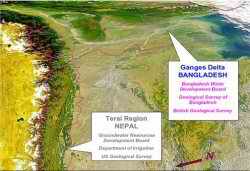 The Ganges originates
from the Gangotri glacier in the Himalayas at the elevation of 7,010 meter
where the length of the main river is about 2,550 km, the catchment area
is about 1,087,300 sq. km. and in Bangladesh lies 46, 300 sq. km. The
Brahmaputra river rises south of the Lake Konggyu Tsho in Tibet (China)
and has a total catchment area of 552,000 sq. km. lying in China (270,990
sq. km.), Bhutan (847,000 sq. km.), India (195,000 sq. km.) and Bangladesh
(39,100 sq. km), (Fig.: 1). The Ganges-Brahmaputra- Meghna river system
carries over 2.9 billion tonnes sediments (one third of global sediment
transport to the world ocean, Milman et al., 1983) into the Bay of Bengal.
Thousands of years of civilisation flourished along the Ganges-Brahmaputra
rivers. The ancient Indians considered that the force behind flowing water
was a god. Mother Ganges or "Ganga Mai" was originally a water
of goddess worshipped by the non-Aryans. Darian describes :
The Ganges originates
from the Gangotri glacier in the Himalayas at the elevation of 7,010 meter
where the length of the main river is about 2,550 km, the catchment area
is about 1,087,300 sq. km. and in Bangladesh lies 46, 300 sq. km. The
Brahmaputra river rises south of the Lake Konggyu Tsho in Tibet (China)
and has a total catchment area of 552,000 sq. km. lying in China (270,990
sq. km.), Bhutan (847,000 sq. km.), India (195,000 sq. km.) and Bangladesh
(39,100 sq. km), (Fig.: 1). The Ganges-Brahmaputra- Meghna river system
carries over 2.9 billion tonnes sediments (one third of global sediment
transport to the world ocean, Milman et al., 1983) into the Bay of Bengal.
Thousands of years of civilisation flourished along the Ganges-Brahmaputra
rivers. The ancient Indians considered that the force behind flowing water
was a god. Mother Ganges or "Ganga Mai" was originally a water
of goddess worshipped by the non-Aryans. Darian describes :
No river has kindled Man's Imagination like the Ganges.... Since Vedic times from 1000 B. C. Indian thought has provided the elements with human counterparts. This personification, in the form or myth, allows humans some recpurse from the otherwise malevolent forces of nature. people pray not to water but to the life within the water.
The Ganges particularly Yamuna are among the most sacred rivers in India or possibly anywhere in the world. Jawahrlal Neheru wrote:
The Ganges, above all the rivers of India, has held India's heart captive and drawn uncounted millions to her banks since the dawn of history. The story of Ganges, from her source to the Sea, from old times to new, is the story of India's civilisation and culture, of the rise and fall of empires, of great proud cities, of the adventure of man....
Unfortunately the rivers of this subcontinent have become the garbage of the nations. 70 per cent of surface water in is polluted (Sibert and Dutta, 1990). The Ganges in particular is full of toxics, including decomposing bodies tossed into it along most of its length, for example at Varanasi about 10,000 half-burned bodies are pushed into the river each year, along with 60,000 carcasses of cows, dogs and buffaloes. Calcutta dumps close to 400 million tonnes of raw into Hooghly Estuary (Hinrichsen, 1990). The State of India's Environment, A Citizen's Report describes:
Out of India's 3119 cities, only 209 have partial sewage facilities and eight have full facilities, besides DDT factories, tanneries, paper and pulp mills, petrochemicals and fertiliser complexes, rubber factories and a host of other use the river to get rid of their wastes.
An Indian's daily diet contain 0.27 mg of DDT and the accumulated DDT in the body tissue of an average Indian is said to range between 12.8 and 31 parts by million which would rank among the highest in the world (Verghese, 1990). It is likely to have the same trend in Bangladesh.
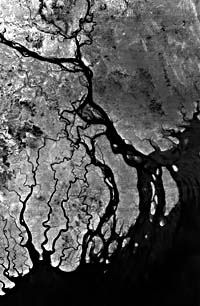 All of Bangladesh's
sewage and industrial wastes are flushed directly into Ganges and Brahmaputra
Rivers. There are widespread fears that as the region develops in industrial
infrastructure, industrial pollution will accelerate, compounding the
problems posed by raw municipal wastes. Since 1982 industrial development
accounts 9 per cent of GDP and the Government is planning for a rapid
increase in industrial products to meet country's vast unemployment. About
900 polluting industries in Bangladesh dispose of untreated industrial
wastes directly into rivers, although the effluents contain 10 to 100
times the allowable levels permissible for human health (Ministry of Environment
and Forest, Govt. of Bangladesh, 1991).
All of Bangladesh's
sewage and industrial wastes are flushed directly into Ganges and Brahmaputra
Rivers. There are widespread fears that as the region develops in industrial
infrastructure, industrial pollution will accelerate, compounding the
problems posed by raw municipal wastes. Since 1982 industrial development
accounts 9 per cent of GDP and the Government is planning for a rapid
increase in industrial products to meet country's vast unemployment. About
900 polluting industries in Bangladesh dispose of untreated industrial
wastes directly into rivers, although the effluents contain 10 to 100
times the allowable levels permissible for human health (Ministry of Environment
and Forest, Govt. of Bangladesh, 1991).
2. THE STATE OF THE RIVERS
The rivers of this sub-continent originate from the Himalayan and mass wasting is very widespread constant faced in all parts of the Himalayan. Besides natural factors they are aggravated by anthropogenic factors such as:
i) loss of forest
cover
ii) extension of agriculture onto steep slopes
iii) open-cast mining without environmental control
iv) roads built without regard for geological and ecological factors.
Economic development in the Himalayan region in the last few decades mainly consists in the felling of forests, the increase export of medical plants, construction of water works, exploration and mining of minerals, enhanced tourism, the introduction of commercial farming together with limited urban industrial growth in the foothills (Stone, 1993). The environmental impact due to mining in the Himalayan region (Utter Pradesh - 4819 ha, J & K State - 886 ha, West Bengal - 1147 ha) includes loss of production (forest, agriculture, pasture), loss of top soil, reduction in flow of water, lowering water tables, hazard of debris, sedimentation of streams and fire hazards etc. (Sahini, 1992).
Between 1951 and 1976 agricultural land increased by 430,000 sq. km (15 percent of land area), much of this through conversion of non-reserve forests which were originally intended to meet rural fodder, fuel and timber supply. Certain groups of plants are particularly at risk notably medical plants due to over-exploitation by the local pharmaceutical industries (Hussain, 1983).
The accessibility introduced by new roads accelerated economic transformation and population growth in a way which had little regard or concern for ecological fragility of the Himalayan region. Forest became denuded, roads and mines created enormous land instabilities, the intensification of agriculture led to soil degradation and erosion, pastures were damaged by over-exploitation while natural courses of rivers were dammed and all these factors together created a massive sedimentation problems. Consequently severe flooding and subsequently followed by drought. experiences India, Nepal and Bangladesh almost every year .
The Ganges-Brahmputra delta, the largest delta in the world suffers water pollution due to several factors such as dense population, no sewerage, removal of natural waters, decreasing dilution, contaminated ground water, river used for waste disposal, no treatment of effluents and increased chemical based agriculture. The categories of wastes create water pollution are as follows:
Liquid Inorganic wastes:
Most of the inorganic liquid wastes come from industry, and their dilution in large river waters renders them harmless. Some inorganic toxic wastes can become concentrated up the food chain to fish. Many of the pollution incidents which have been resulted in many parts of the world in largest number of deaths and serious injuries from water pollution have been arisen from human ingestion of fish, or crops contaminated with heavy metals or other inorganic compounds.
Liquid Organic Wastes:
Wastes when disposed of in water, bacteria and other micro-organisms combine with oxygen dissolved in water to break them down, can be termed as "oxygen demanding" wastes. Liquid organic wastes include sewage, many wastes from industries (especially industries producing agricultural and tannery products) and run-off from rains, floods and storms which picks up organic wastes from land, before flowing into streams, rivers, lakes or seas. As concentration of dissolved oxygen decreases, so fish and aquatic plant life suffer or die. According to Department of Environment, Government of Bangladesh (1988), Karnaphuli River shows following intolerable BOD values: at Kalurghat (tannery and food processing industrial area) 800 - 12,000 ppm, at Chandragahna (paper mill) 60 ppm. Industrial wastes also creates a very high chemical oxygen demand (COD) ranges between 75-600 mg/l. Besides, Buriganga River near Dhaka shows BOD between 5-75 mg/l. A wide spread of fish deaths have occurred in these areas, and thousands of fishermen have lost their jobs. In Damodar river, near Calcutta BOD level rises upto 30 mg/l (Rao, et al., 1991).
Waterborne or related pathogens:
Many pathogens (disease causing agents including bacteria, viruses and worms) are spread in water - either through human ingestion of contaminated water or because water provides the habitat for intermediate hosts. Outbreak of floods in Bangladesh causes disease epidemics of dysentery and other waterborne and water-washed diseases, as floods contaminate all available water supplies.
The surface water contamination poses greatest threat from Industrial, Municipal and Urban Wastes and Agriculture.
2.1 INDUSTRIAL, MUNICIPAL AND URBAN WASTES :
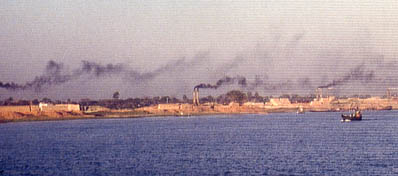 In 1987 India exported about US $ 500 million leather. About 250 different
toxic chemicals and heavy metals like cadmium, chromium, arsenic, zinc
etc. are used by the leather industry and these wastes are disposed of
in rivers (Dittfurth and Röhring, 1987).There are about 2,000 tanneries
in India with an annual processing capacity of 500,00 tonnes of hide and
skin. Besides other toxic chemicals, annually 25,000 tonnes of chromium
salt is used and out of this 10,000 tonnes of chromium salt in the form
of Basic Chromium Sulphate is discharged into waste water streams causing
environmental pollution (Schaapman, Rajmani and Pelckmans, 1990).
In 1987 India exported about US $ 500 million leather. About 250 different
toxic chemicals and heavy metals like cadmium, chromium, arsenic, zinc
etc. are used by the leather industry and these wastes are disposed of
in rivers (Dittfurth and Röhring, 1987).There are about 2,000 tanneries
in India with an annual processing capacity of 500,00 tonnes of hide and
skin. Besides other toxic chemicals, annually 25,000 tonnes of chromium
salt is used and out of this 10,000 tonnes of chromium salt in the form
of Basic Chromium Sulphate is discharged into waste water streams causing
environmental pollution (Schaapman, Rajmani and Pelckmans, 1990).
The Ganges and her tributaries flow through main industrial sites, cities and agricultural lands of India and enter the deltaic plain of Bangladesh (Fig. 1). The River Ganges flows through 700 cities in India, and about 120 million litres of waste waters from the industries and municipalities are added daily. The Ganges at Calcutta obtains daily 252 million gallons of liquid wastes, and of which 77 million gallons is industrial wastes (Dept. of Environment, Govt. of Bangladesh, 1988). The State India's Environment, a Citizen's Report points out that of India's 3119 cities, only 209 have partial sewage and sewage facilities and eight have full facilities. The report further adds:
DDT factories, tanneries, paper and pulp mills, petrochemical and fertiliser complexes, rubber factories and a host of others use the river to get rid of their wastes from more than 150 major factories around Calcutta ... raw sewage pours into the river continuously from 361 outfalls.
The National Commission of Urbanisation in India reports (August, 1985):
A major feature of our urban scene is misery and serious health hazards caused by lack of water supply and sanitation. Almost all our urban centres, even those which at one time had reasonably adequate water supply, are now suffering from crippling shortage.
River Yamuna that
flows to the Ganges consider to be highly polluted. Verghese (1990) reports:
Civic and industrial pollution pose a threat to fish and other aquatic
life. Tannery discharges into the Ganges at Kanpur have resulted in toxicity
levels that are inimical to fish. Fishermen report virtual absence of
fish in certain reaches. Effluents draining into the Yamuna via the Hindon
from Ghaziabad have from time to time resulted in mass fish-kills at Okhla
in Delhi. Pollution destroys fish directly by poisoning and reducing the
oxygen content, killing fish food and affecting spawning grounds. Some
species of air-breathing fish might survive in polluted waters but bottom
dwellers find the water devoid of plankton and benthos. Persistent pollution
can cause mutation and bring about genetic changes. Arsenic, mercury,
chromium and other heavy metals pollutants are dangerous as they tend
to accumulate in fish tissues and can enter the human system through food
chain........Bandel to Budge on the Hoogly at Calcutta is yet another
badly polluted stretch.
The present economic
development increasingly widens the gap between the poor and the rich.
The limited agricultural land does not allow any further expansion along
with the fast expanding population of working age. In view of this problem
the Government of Bangladesh is planning for a rapid increase in industry,
commerce and services (55.7 per cent of GDP). At present industrial manufacturing
accounts for about 10 per cent of GDP in Bangladesh and 10 per cent of
total employment, and contributes about three-quarters of total merchandise
exports. The earliest industries in Bangladesh were based primarily on
agricultural products like jute, sugarcane, tobacco, forest raw materials,
and hides and skins. During the mid-sixties a modern industrial base emerged
as heavy industries like steel, machine tools, electric machines, diesel
plants, refineries, pharmaceutical plants and other chemical industries
were set up. From 1985 to 1990 the industrial sector achieved an average
annual rate of growth of 4.02 per cent. In recent years, the major source
of industrial growth has been in textiles, with ready-made garment manufacture
expanding from insignificance in the 1970s to the leading export earner
today. Leather tanning and brackish water shrimp farming have also expanded
rapidly and are expected to grow further.
The industrial areas in Bangladesh are situated in the midst of densely
populated regions. There are many hazardous and potentially dangerous
polluting industries situated in the cities of Bangladesh. In Dhaka at
Tejgaon area, food processing industries are situated along with chemical
and heavy metal processing industries. In Tongi a pharmaceutical industry
is situated near a pesticide producing industry. Tannery industries of
Hazaribagh also situated in a heavily populated residential area. These
examples are repeated in the cities of Chittagong, Khulna and other smaller
cities of Bangladesh. The Government of Bangladesh has not shown much
interest in environmental impact created by the industries, whereas government's
concern to create jobs usually meant that when a new factory is proposed
- by local, national or international business or agency - little attention
is given to the likely environmental impacts.
Surface water pollution in Bangladesh occurs mainly by human sewage coupled with municipal garbage and industrial effluents. Industrial discharges along with municipal and urban wastes are creating special problems that completely destroy the microbial-based systems of decomposition.
About 6,000 large and medium industries and 24,000 small industries are operating in Bangladesh which discharge effluents directly to the rivers or nearby canal or waterbed without any regard to environment. According to the Department of Environment, Government of Bangladesh about 903 polluting industries such as 176 tanneries, 5 paper and pulp plants, 16 sugar mills, 3 distilleries, 57 iron and steel mills, 298 textile units, 5 fertiliser plants, 23 insecticide industries, 92 jute industries, 3 cement industries, 34 rubber and plastic industries and 166 Pharmaceutical industries are the most polluted industries of Bangladesh. Under the Environmental Pollution Control Ordinance of 1977 are not required to take clearance from the Government for their project plants, permits or consent for discharge of pollutants. Other sources of water pollution are disposal of hazardous wastes from boats and ships, and dumping of scrap from ship breaking yeards.
So far there is no monitoring facilities for controlling or inventorying on water qualities of rivers of Bangladesh. The status of some polluting rivers are as follows (Figs.: 1 and 2):
2. 1. 1. Buriganga River
All industrial, municipal
(700-1100 tonnes daily) and urban wastes of Dhaka city ( population 1989
about 6.5 million and expected to grow in year 2000 to 11.1 million) are
flushed into the Buriganga River. It is estimated that total organic waste
load discharged into the river will be around 250 metric tonnes per day
(Reazuddin, 1994). The Department of Environment, Dhaka Division has selected different sampling locations. The choice of DoE's sampling station in Buriganga is based mainly on the location along the river banks. The selected locations are Hazaribagh, Chandnighat and Pagla where the major pollution sources from tanneries, city sewage and sewage treatment plant respectively Water chemistry The results indicate that Buriganga river is one of the major polluted rivers in the country, with Hazaribagh station being the most polluting station. Dissolved Oxygen (DO) at Hazaribagh can be as low as 2 mg/L during January to May. Total solid and chlorides are also sharply higher here. Hazaribagh is estimated to discharge water around 16,000 m3/day generating about 18 MT of Biological Oxygen Demand (BOD) per day into Buriganga. In addition, Hazaribagh main effluent drain discharges waste water from tanneries which contains high levels of Chemical Oxygen Demand (COD) in the order of 1100 mg/L and chromium at about 11.5 mg/L. Seasonal variation of DO and BOD are also observed. During flush season, DO increases to the level of 4-5 mg/L and BOD reduces to the level of 3-4 mg/L which is just critical level for recreational and domestic use The situation of Chandighat, which is in the middle of the river, is as bad as Hazaribagh excepting in terms of chemical Oxygen Demand (COD) load. In Pagla, though there is discharge from Pagla sewage Treatment plant, the result indicates a higher level of oxygen compared to Hazaribagh and Chandighat stations. In addition, data on Total Solids and Turbidity indicate that the river is highly turbid and waded with solids residues almost throughout the river. The reasons for high pollution and oxygen for most of the length of the river may be attributed to the discharge from Rayer Bazar sluice gate, Dolai Khal, Pagla Sewage Treatment Plant, hanging latrines. Sources of pollution load from industries include Hazaribagh tanneries, Tejgaon industries and others which discharge waste water around 15,800, 3,500 and 2,700 m3/day respectively and generate around 17,000, 1,850 and 1385 BOD 5/day respectively (BCAS, 1998)..
Hazaribagh Leather Industry
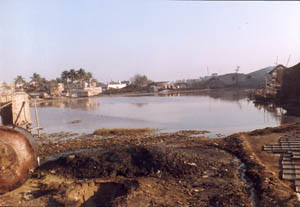 The annual supply
of hides and skins in Bangladesh is estimated to be about 13.95 million
square meters. Only 15-18 per cent of the total supply is needed to meet
the domestic requirements and the rest about 11.81 million square meters
remains surplus for export.
The annual supply
of hides and skins in Bangladesh is estimated to be about 13.95 million
square meters. Only 15-18 per cent of the total supply is needed to meet
the domestic requirements and the rest about 11.81 million square meters
remains surplus for export.
The small leather industry of Indian-subcontinent developed Indian vegetable
tanned crust over a hundred years ago to preserve the hide in the safest
way to suit Indian conditions. The development of leather processing industry
was started in Bangladesh in the late 1940s. Until mid 1960s, the leather
was dominated by vegetable tannage for supply to W. Pakistan, Iran and
Turkey. Manufacture of wet blue, the chrome tanned semiprocessed leather
started featuring in 1965. There was a rapid growth of tanning industry
in Bangladesh during 1970s and by the end of 70s. Until 1980-81, the export
from leather sector was almost 100% in the form of wet blue, the chrome
tanned semi-processed leather (Table: 1).
In 1977 the Government of Bangladesh imposed export duty on wet blue leather
so that the industry produces crust and finished leather. With the ban
on wet blue export from July, 1990, the leather industry of Bangladesh
is entering into second phase of its development, the conversion of finished
leather into further value added leather products to earn more foreign
exchange. Promotion and Protection Act of 1980 provides protection of
foreign investment in Bangladesh. There are German, Italian etc. joint
venture plants are established in Bangladesh (M/S H. H. leather Industries
Ltd, M/S BATA, M/S Lexco Ltd, M/S Apex Tannery Ltd).
The operation in tanning which give rise effluents may be categorised
into pre-tanning and post-tanning processes. Pre-tanning is employed mainly
for the removal of impurities from the raw materials. These consist largely
of protein (blood, hair, etc.) and the process chemicals employed include
salts, lime and sulphides. The tanning processes themselves are used to
alter the characteristics of skin or hide and their effluents contain
chromium and vegetable or synthetic tanning. Post-tanning process include
coloration and produce effluents typical of these addition processes;
that is, containing residues of dyestuffs or pigments and larger quantities
of auxiliary chemicals. The process chemicals employed are a variety of
inorganic and organic materials, affecting total solids, pH, COD and of
particular importance are the applicable quantities of sulphide and of
heavy metals. Hazardous chemicals for leather and dyes treatments are
Ammonium Bicarbonate, Chromic Acetate, Ethylene Glycol Monoethyl Ether,
Methylamine, o-Nitrophenol, Toulene Diamine, 2,4,5-Trichlorphenol, Zinc
Hydrosulfite, Zinc Sulfate, tert-Butylamine, Cadmium Nitrate, Cadmium
(II) Acetate, Copper(2)Nitrate, 1,4-1,8 Dichloronaphthalene, Nickel Sulphate,
o-Xylene, Zinc Nitrate etc.170 tanneries of Hazaribagh generates waste
water about 5,000 litres/100 kg of hides and skins. BKH Consulting Engineers
in 1986 reported the following characteristics of the effluents:
| pH | 4-10 |
| Total alkalinity as CaC03 | 185-6475 mg/l |
| Electrical conductivity | 670-5300 (Micro-mhos/cms) |
| Chloride | 175-18000< mg/l |
| Chromium | 3-28000 mg/l |
| COD | 120-9600 mg/l |
| Ammonia nitrogen | 12-1970 mgl |
Tubewells for drinking
water adjacent to the down-gradient from the Hazaribagh industrial area
is highly polluted.
For example Chromic Acetate shows the following characteristics (Sax,
1986):
Potential of Accumulation
Positive
Food Chain Contamination Potential
Positive, can be concentrated in food
chain
Etiologic Potential
Chrome ulcer
Carciniogenecity
Potential, higher occurrence of lung cancer
Acute Hazard Level
Extremely toxic if ingested or inhaled. Corrosive
to living tissue
Degree of Hazard to Public Health
Highly toxic material via ingestion
or inhalation. Corrosive to skin and mumem; potential carcinogenic
At present in Bangladesh the tanner's basic wet process technique is to
treat the stock with increasing concentrations of process chemicals using
water as the carrier. In order to ensure full penetration of the thickest
hide or skin in the batch, these concentrations are in excess of what
is needed and the unabsorbed chemicals are discharged in the effluent,
where they are a waste and cause expensive treatment problems.
While the
Chemical companies in the Federal Republic of Germany, the United States,
the United Kingdom, Switzerland, Spain and Italy provide short term training
on the application of their chemicals, Whereas they do not provide any
assistance how to treat toxic effluents that increasingly contaminate
surface and ground water. Consultants provide technological transfer and
management either on arm's length fee paying basis on assignment or financed
by the World Bank, UNIDO, ITC or other United Agencies.
The small cottage tanners of Hazaribagh producing sandal leather out of
cow heads are probably the only tanning group in the world using waste
tanning liquor from the modern tanners as their process liquor. But after
using these waste are eventually discharged, as are all other tannery
discharges in the Hazaribagh tanning effluents into the streets, gutters
and sewers which ultimately enter surface and ground water.
According
to Dittfurth and Röhring (1987) about 250 different toxic chemicals
and heavy metals like cadmium, chromium, arsenic, zinc etc. are used by
the leather industry. When the local industry was basically a vegetable
tanning complex, this effluent might have been high in BOD and unpleasant
but particularly dangerous.
There is, in addition, an extremely hazardous air pollution occur in Hazaribagh
which is not known in any other places of the world. The rest treated
hides and skins are cooked in open air to obtain glue for the local market.
They burn treated leather pieces instead of coal or wood as it is cheaper.
The smog and the smell like a witch cooking pot and it is beyond author's
capability to narrate.
The most hazard occurs when the poorer group uses
poisonous treated leather pieces as an alternative fuel to cook regular
meals. No body knows how much harm and potential carcinogen diseases will
occur to the slum inhabitants. There is no warning from the Government
or aid giving agencies or their representatives. This is the vicious circle
that the poorest groups are the worst victims of the foreign currency
earning schemes.
2. 1. 2. Sitalakhya River
Besides wastes from Dhaka urban population the river receives untreated industrial wastes from urea fertiliser plants, textile mills and other industries. The principal polluting agent in the region is the Urea Fertiliser Factory of Ghorasal and the concentration of ammonia dissolved in water has increased over time causing fish-kills.
2. 1. 3. Balu River
The river near Tongi (15 miles north of Dhaka) receives untreated effluents from industries such as textiles, lead batteries, pulp and paper, pharmaceuticals, paints, detergents, iron and steel, rubber etc.
2. 1. 4. Bhairab/Rupsa Rivers
The principal industries of Khulna (south-east of Bangladesh) are jute mills, oil mills, newsprint mills, cable, shipyards, tobacco, match factories, hardboard and others dispose molasses, starch, oil, sodium-sulphide, ethane, lissapol, sodaash, dye, sulphuric acid, salicylic acid, lime, ammonium sulphide, and chrome etc. Afew study at Bhairab River shows a very alarming water quality data (Nov.-April 1988-89) - conductivity 390-9500 Micro-mhos/cms, total solid 260-3500 mg/l, TDS 260-3200 mg/l. The pollution aspects of Bhairab and Rupsa Rivers is very critical - the Rupsa River does not receive a continuous flow of fresh water from the parent river, on the other hand, the Bhairab River, being subject to tides, has marked backwater effects which reduce the purification capacity of the river.
2. 1. 5. Karnaphuli River
The polluting industries
of Chittagong (south-east of Bangladesh) such as 19 tanneries, 26 textile
mills, 1 oil refinery, 1 TSP plant, 1 DDT plant, 2 chemical complexes,
5 fish processing units, 1 urea fertiliser factory, 1 asphalt bitumen
plant, 1 steel mill, 1 paper mill (solid waste disposal hourly 1450 m³),
1 rayon mill complex, 2 cement factories, 2 pesticide manufacturing plants,
4 paint and dye manufacturing plants, several soap and detergent factories
and a number of light industrial units directly discharge untreated toxic
effluent into Karnaphuli river. From the survey of effluents from different
industries , it has been found that the discharge is generally compose
of organic and inorganic wastes.
The organic waster are the effluents
from the tanneries, fish processing units, degradable wood chips, pulps
and untreated municipal and sewage (about 40,000 kg BOD daily) etc. The
inorganic waster are chemicals used by the industries such as various
acids, bleaching powder, lissapol, hydrogenperoxide, alkali, salts, lime,
dyes, pigments, aluminium-sulphate and heavy metals etc.
The DDT factory and fertiliser factory disposing of DDT, toxic chemicals and heavy metals
to the Karnaphuli River and ultimately to the Bay of Bengal ( Table: 2
and 3). The tables show about 220 ppm of chromium, 0.3-2.9 of cadmium,
0.05-0.27 ppm of mercury, 0.5-21.8 ppm of lead entering river and sea
water much higher than allowable limits. and extremely alarmingly to aquatic
flora and fauna and through food chains to human beings. It may be mentioned
that Bangladesh obtain table salt from solar drying of sea water and consequently
increase pollution of sea water shall create a serious national health
hazard situation.
About 20,000 fishermen became jobless at Rangonia, Boalkhali and Anwara Upazila due to water pollution (Dept. of Environment, 1988). The estimate of crude oil spillage at Chittagong is about 6,000 metric tonnes per year, while about 240,000 gallons per year of bilge water is also dumped (Ministry of Environment, 1992). Polycyclic aromatic hydrocarbons known to be carcinogenic enter the river water and also the Bay of Bengal. But no specific study or quantitative analysis of the run-off, discharge amount or residue level has so far been analysed.
3. POLLUTION FROM AGRICULTURE
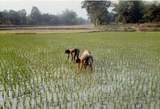 India currently uses
about 5 million tonnes of fertiliser, around 12 000 tonnes of pesticides
and manufactures 55 varieties of pesticide, of which DDT, BHC and malathion
account for half of the output (Verghese, 1990). In Bangladesh during
1979-80 total use of pesticides was nearly 2,3047 tonnes, whereas the
use rose during 1984-85 to nearly 4,000 tonnes, during 1989-90 to more
than 5,000 tonnes and during 1992-93 about 7,200 tonnes. Indiscriminate
and excessive use of pesticides in increasing amount are posing greatest
threat to surface water pollution in the Ganges-Brahmaputra delta plain.
DDT and other highly toxic pesticides (Dirty Dozen) are indiscriminately
used by the farming community.
India currently uses
about 5 million tonnes of fertiliser, around 12 000 tonnes of pesticides
and manufactures 55 varieties of pesticide, of which DDT, BHC and malathion
account for half of the output (Verghese, 1990). In Bangladesh during
1979-80 total use of pesticides was nearly 2,3047 tonnes, whereas the
use rose during 1984-85 to nearly 4,000 tonnes, during 1989-90 to more
than 5,000 tonnes and during 1992-93 about 7,200 tonnes. Indiscriminate
and excessive use of pesticides in increasing amount are posing greatest
threat to surface water pollution in the Ganges-Brahmaputra delta plain.
DDT and other highly toxic pesticides (Dirty Dozen) are indiscriminately
used by the farming community.
In Bangladesh total
production of rice (Aus, Aman, and Boro) and wheat increased from 9.9
million tonnes in 1972/73 to 19.1 million tonnes in 1990/91. This has
been achieved through extensive cultivation of HYVs (High Yield Varieties)
of rice and wheat with extensive use of fertilisers, pesticides and irrigation.
The total area under irrigation has increased from 1.2 million hectares
in 1973 to 3.1 million hectares in 1989 (Ministry Environment and Forest,
Govt. of Bangladesh, 1991).
Year round transplanted rice cultivation keeps
the land water-logged continuously for many years. Fertilisers and some
pesticides are leaching through the soil into shallow groundwater's. There
is no available systematic studies on nitrate contamination in Bangladesh.
A rapid increase in nitrate content is expected in the rural areas of
Bangladesh. About 20 percent of the rural population obtain drinking water
from surface sources, whereas the rest rely on shallow tube-wells (30-60
meter depth). High mortality death rate of children under the age of five
indicating increasing pollutants in drinking waters. Maintaining high
quality groundwater will require practical approaches to prevent contamination,
because of the increasingly vast areas involved.
The traditional varieties of rice such as Aman, Boro, Aus etc. are replaced in many areas by HYV. At present the farmers complains that a declining yield of HYV rice despite increasing use of chemical fertilisers and pesticides. Year round mono-cropping resulted in Bangladesh depletion of soil nutrients, formation of toxic compounds in soil and about 1.74 million ha land is deficient in essential nutrients (sulphur, zinc). This has caused 10 per cent crop reduction, 17 per cent for rice crop (Ministry of Environment and Forest, 1991).
The Government and many Organisation in Bangladesh reported that the deterioration in soil fertility is attributed to continuous monocropping of rice, particularly HYV rice. The daily "Bhorer Kagag" reports on November 11, 1994 almost all HYV rice fields in the southern districts of Bangladesh are severely destroyed by the insects, whereas 16 districts of the northern part of Bangladesh seriously lacking of essential trace minerals (crop production will reduce to 40-50 % within the next three to four years).
After the construction embankments, where the HYV cultivated, agricultural land does not receive fresh fertile sediments, algae and water that keep ground water level high during dry season, depleting natural soil to nutrient poor soil. The loss of vital nutrients like illite, montmorillonite clay minerals, silt, organic matters (nitrogen supplying algae) are compensated by chemical fertilisers. The environmental aspects of surface water development projects have been neglected by the planners and engineers. In the planning of projects farmers requirements and knowledge are not considered. Mainly engineers' decisions and designs are imposed on them (Khan,1987).
For example under
the Ganges-Kobadak Irrigation Project construction of flood embankments
produced flowing rivers like Kumar, Kaliganga and Dakua to dead rivers
which created a serious ecological disaster. Another example of ecological
disaster is Horai River Sub-Project where in February 1989 the inlet of
the Horai River at the Padma (Ganges) end closed down which resulted 20
beels (wetlands) of 9,000 acres dried up. Besides the loss of wetland
prevented the annual recruitment of fish prawn and nutrient rich water
from the Padma (Ganges) river.
If the current trend continues, in twenty
years about 2 million ha flood plains would have been permanently removed
due to flood control and drainage development (Ministry of Environment
and Forest, 1991). After China and India Bangladesh is the third largest
country in the world in inland fisheries. But at present the average yields
for inland fishery are low and declining by about 2.7 per cent a year.
However, this decline have been offset by increased inland culture fisheries
by the richer group of rural population.
But the poorer group of the rural
population (more than 80 per cent) who used to catch fish from the floodplains
as the only source of animal protein is interrupted from this source due
to structural measures and increasing surface water pollution. In 1960
average caloric intake in Bangladesh was more than 2,300 which reduced
to 1,920 in year 1990. A large number of children in poor families become
blind every year because of nonavaility of proper diet.
In fact, the short and long term strategy of the supplying industry is to maximise the use of chemicals and use new biotechnique to broaden the applicability of pesticides. (Mooney et al.,1988). Chemical companies recognise that there is a bonanza awaiting manufacturers who can create seeds like herbicides. It is undoubted that "the green revolution" has opened the world wide market of the agrochemical industry.
There were about 30,000 rice varieties cultivated by farmers in the Indian-Subcontinent and at present only 15 varieties comprise 75 percent of rice cultivation. Monoculture creates a market for crop chemicals. More advanced varieties of seed will lead to more toxic chemicals, greater risk for farmers, achieves only more environmental damage. Pat Mooney and Cary Fowler, the Noble Prize winners of 1985, described it as "genetic erosion", most prominent of all is the environmental erosion.
4. DISCUSSION: MANAGEMENT - BEYOND CONTROL
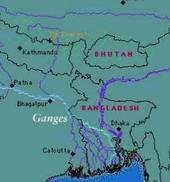 About 10 per cent of global population is living in the Ganges-Brahmaputra
delta and the population is increasing more than 2.6 per cent annually
and the it will double in 27 years. In view of this the governments of
this region have increased the production of chemical based agriculture
(Monoculture) and rapid industrialisation programme without considering
environmental impacts. The non-point sources of water pollution have increased
tremendously and even if all the major industries and urban and municipal
sewage obtain cleaning systems water quality will deteriorate due to non-point
sources.
About 10 per cent of global population is living in the Ganges-Brahmaputra
delta and the population is increasing more than 2.6 per cent annually
and the it will double in 27 years. In view of this the governments of
this region have increased the production of chemical based agriculture
(Monoculture) and rapid industrialisation programme without considering
environmental impacts. The non-point sources of water pollution have increased
tremendously and even if all the major industries and urban and municipal
sewage obtain cleaning systems water quality will deteriorate due to non-point
sources.
India ranking among
the ten most industrialised nation with GDP about 5-6 per cent yearly
has brought unwanted and unanticipated consequences, including unplanned
urbanisation, pollution and risk of accident. Most industrial plants use
outdated, polluting technologies and makeshift facilities (Centre for
Environment Education, India, 1992). It is praiseworthy that in 1985 India
lauchned Ganga Action Plan when Prime Minister of India declared "we
will restore the pristine purity of Ganga". The plan intends:
The Ganga Action Plan is a 532 cores Rupees project believes an expert of the Thames Water International that some of the quality norm set are questionable or may be unattainable (Verghese, 1990). The management problems are:
The Ganges transports 83 million tonnes of dissolved solid along with 2.5 per cent of global flux of sodium to the oceans, whereas the Brahmaputra transports 35 million tonnes of dissolved solid to the Bay of Bengal (National Environmental Engineering Research Institute, India, 1987). 70 per cent of surface waters in India is seriously polluted (Sibert and Dutta, 1990 and Centre for Environment Education, India, 1992).
The major rivers of
India along with polluted load flow deltaic plain of Bangladesh and finally
to the Bay of Bengal. In Bangladesh the combined flow of the Ganges and
Brahmputra typically increasing from less than 10,000 cubic meter per
second early in the year (dry season) to a peak of 80,000 to 140,000 cubic
meter per second in late August or early September. Shortage of water
in dry season is exacerbated by the diversion of Ganges at the Farakka
Barrage, India. During dry period (November to April) surface water pollution
increases especially down streams of Industries and cities.
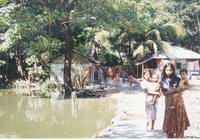 UNICEF (1986)
reports that in 1983 there were over 57 million episodes of diarrhoea
among children under five causing an estimated 200,000 child deaths. The
National Cancer Society of Bangladesh on Nover 4, 1994 reports that about
800,000 persons are at present suffering from cancer and about 150,000
deaths annually occur in the country (Daily Sangbad, November 4, 1994).
There is no study that correlates diseases to environmental impacts. But
there is no doubt that most of the diseases are related with surface water
pollution, as in Bangladesh vast majority of the rural population uses
ponds and other surface sources and only 2-4 per cent of the population
has a sanitary latrine.
UNICEF (1986)
reports that in 1983 there were over 57 million episodes of diarrhoea
among children under five causing an estimated 200,000 child deaths. The
National Cancer Society of Bangladesh on Nover 4, 1994 reports that about
800,000 persons are at present suffering from cancer and about 150,000
deaths annually occur in the country (Daily Sangbad, November 4, 1994).
There is no study that correlates diseases to environmental impacts. But
there is no doubt that most of the diseases are related with surface water
pollution, as in Bangladesh vast majority of the rural population uses
ponds and other surface sources and only 2-4 per cent of the population
has a sanitary latrine.
The present liberalised industrial policy in Bangladesh ignores environmental protection - private entrepreneurs do not require permission from any quarter. Banks in general accord permission to the project, if it is financial viable. With the increase of unplanned and socially and environmentally degraded industries Bangladesh poses a new challenge. Pollution and human-induced hazards are particularly serious in the developing nations, because industrial production is heavily and scatteredly concentrated in city regions or 'core regions' within each nation.
The deterioration
of surface water quality is a serious problem in this subcontinent and
it will grow further if the present policy of industrialisation and agricultural
practice continues. A recent study which covers most of the subcontinent
shows that between 1890 and 1970, more than 30 million hectares of land
were transformed from forest and grassland into areas of crop production
and settlement (Tucker, 1988).
Most of Bangladesh was originally forested,
with coastal mangroves backed by swamp forests and a broad plain of tropical
moist deciduous forests. Remnants of these forests, the Sunderbans, still
the largest mangrove forest of the world is threatened (ODA inventory
in 1983 reveals that Gewa and Sundri declined to 40-45 % since 1958-59)
due to structural measures in the Ganges River and over-exploitation.
Almost half of Bangladesh is wetland but the size of wetland is dramatically
decreasing year by year. For example Chalan Beel (wetland) considered
to be the largest wetland in Bangladesh, now covers only a quarter of
100,00 hectares that it covered 150 years ago. If the current trend continues,
in twenty years 2 million ha of flood plain will be permanently removed
(Ministry of Environment, 1991).
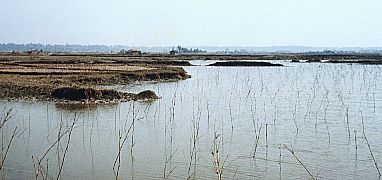 Shrimp farming in Bangladesh rank third
in earning foreign exchange (1983 production 2,200 tonnes, 1986 production
12,878 tonnes) contributed 10.94 % of total export earnings in 1988-89.
This increase production accompanied by the destruction mangrove forests
in the coastal region of Bangladesh (Anwar, 1993). In December 1994 the
daily newspapers of Bangladesh reported a massive shrimp-kill in the coastal
region due to unknown virus infection. Besides clearing mangrove forests
and destroying aquatic larvae of coastal region, these shrimp farms threw
about 23,000 metric tonnes of shrimp heads into the nearby waters every
year without any regard for the decomposition, increase in BOD content,
killing aquatic habitat and degrading drinking water quality.
Shrimp farming in Bangladesh rank third
in earning foreign exchange (1983 production 2,200 tonnes, 1986 production
12,878 tonnes) contributed 10.94 % of total export earnings in 1988-89.
This increase production accompanied by the destruction mangrove forests
in the coastal region of Bangladesh (Anwar, 1993). In December 1994 the
daily newspapers of Bangladesh reported a massive shrimp-kill in the coastal
region due to unknown virus infection. Besides clearing mangrove forests
and destroying aquatic larvae of coastal region, these shrimp farms threw
about 23,000 metric tonnes of shrimp heads into the nearby waters every
year without any regard for the decomposition, increase in BOD content,
killing aquatic habitat and degrading drinking water quality.
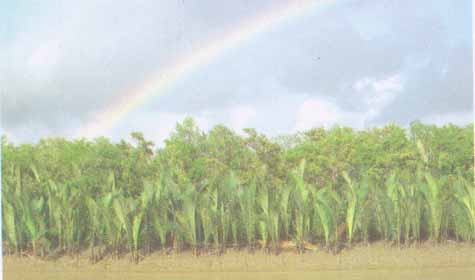 Apart from many other
beneficial effects of forest and wetland, they improve water quality by
toxic substances removal, conversion of inorganic material to organic
material, metabolism of phosphorous, nitrogen and other nutrients, suspended
solid removal and removal of pathogen etc. Destruction of natural water
purification systems throughout the Ganges-Brahmaputra River system increasingly
deteriorating surface and ultimately ground water of this region.
Apart from many other
beneficial effects of forest and wetland, they improve water quality by
toxic substances removal, conversion of inorganic material to organic
material, metabolism of phosphorous, nitrogen and other nutrients, suspended
solid removal and removal of pathogen etc. Destruction of natural water
purification systems throughout the Ganges-Brahmaputra River system increasingly
deteriorating surface and ultimately ground water of this region.
The point and non-point sources of surface water pollution are creating chemical and biological contamination, channel contamination and basin contamination and the existing management efforts are incapable to meet the problems. CIDA (1988) describes that environmental policies in Bangladesh Governments plans and priorities are conspicuous by their absence and where they exist they are inadequate, outdated or unforceful. While the Government's proposed industrial pollution regulation is sensible, is implementation will require considerable technical and corruption-free management's. It will take decades for controlling the proposed act. The region requires:
pollution prevention and conservation of natural environments, cheaper technology for effluent treatment and social change for a sustainable development.
Pollution Prevention and Conservation of Natural Environments
While developing countries are rapidly increasing the use of chemical fertilisers and pesticides, in developed countries agricultural issue moving higher on the public's agenda is the use, and over-use, of pesticides and fertilisers. For example, the National Environmental Policy of Plan in the Netherlands sets an overall goal to reduce the use of fertilisers and pesticides - by the end of this decade the use of pesticides should be cut in half. A 1987 law in Denmark gives farmers financial support to develop or convert to organic farming. Whereas in Bangladesh structural measures to grow HYV (High Yield Varieties) of crops prevent nutrient rich flood-water to enter the fields, replaced by increasing use of chemical fertilisers and pesticides. It may be mentioned that a bumper crop was recorded in Bangladesh after each major flood, when flood-water over-topped the embankments. The Ganges-Brahmaputra Rivers transport annually 2.9 billion tonnes (one third of global sediment transport) of nutrient rich sediments to the Bay of Bengal and there is no effort in the country to utilise this unique natural gift. Bangladesh urgently needs to develop improve farming techniques for traditional varieties under regulated flash of annual nutrient-rich flood waters in the agricultural land and reducing reliance on chemicals (Anwar, 1993).
Recently Bangladesh School Text Book Board introduced environmental studies in the secondary schools, but the books are the older version of the geography curriculum. It is reported that many hazardous pesticides are used for the conservation of food, medicinal treatments etc. (Anwar, 1993). Bangladesh requires an education system that is understandable to rural population., that includes:
Cheaper Effluent Treatment Technology:
Some studies report that most of the industries will not be profitable after installing modern effluent treatment plants. The conventional physical, chemical and biological treatment methods are very expensive and Bangladesh with is present resources can hardly afford such technology.
Several studies on wastewater effluents (secondary sewage, drainage wastewater,
livestock waste, industrial wastes etc.) have been investigated. Dymond
in 1948 first suggested the possibility of using waterhyacinth for the
removal of nutrients from wastewater effluents. Experimental studies show
a high rate of absorption of several heavy metals from paper mill effluents,
tannery wastes and fertiliser factory waste. Field studies in Mississippi
report that waterhyacinth reduces suspended solids, nitrogen, phosphorous,
faecal colioform (the presence of colioform organisms is regarded as evidence
of faecal contamination since these organisms have their origin in the
intensial tract of humans and other warm-blooded animals), and (BOD) Biological
Oxygen Demand (McDonland et al., 1980). Dissolved oxygen perhaps the most
commonly employed parameter of water quality, whereas with the increase
with biological oxygen demand (BOD) due to increase in organic matter
in water may lead to a low level of dissolved oxygen. A high BOD adversely
affects fish and other aquatic life. Mosse and Chagas (1984) also found
about 83.4% reduction in total coliforms and 89.6% reduction in fecal
coliforms from sewage effluents passing through waterhyacinth ponds in
Brazil.
Most studies suggest that a simple passage of wastewater through a waterhyacinth pond improves water quality. The mechanisms involve in wastewater purification using waterhyacinth are similar to conventional treatment facilities. The waterhyacinth-covered wastewater receiving ponds represent a unique environment which is also stable if the water inflows and organic loading are steady. Every system of wastewater treatment units requires specific design and operation programme for maximum efficiency.
The recent scientific studies on waterhyacinth advocate that instead of wasting valuable resources on control efforts, the weed should be turned an asset in the developing countries as it can combat water pollution. In Bangladesh conventional treatment of wastewater is not available and beyond economic means. As an inexpensive and affordable method the waterhyacinth can be used to reduce or eliminate suspended solids both organic and inorganic, nutrients, heavy metals, pesticides and organic compounds. The industries of industrial countries are interested to transfer expensive and ever dependable technology to the developing countries. On the other hand interested groups in the developing countries can not earn enough from such projects.
Social Change
More than 10 per cent
of world's population lives in the Ganges-Brahmaputra delta plain and
if an average person in the South were to consume as much as an average
person in a developed country, the environmental crisis would be unimaginable.
The developing countries have so far followed strategies that are modelled
after the experience of industrialisation of the developed societies.
The developing countries fear that the concern for the environment would
delay their material and social progress.
However, it is now considered
that the natural environment will soon be destroyed by biochemical pollution,
if we do not change our present methods of producing goods. In developing
countries the pollution of a river and the killing of its fish may often
lead to famine, whereas the extreme pollution of the Rhine or the Great
Lakes would not have a similar consequence for the neighbourhood population.
The development projects in Bangladesh benefit richer society . The International
Assistance Programme of the Government of the Netherlands comments on
projects in Bangladesh (1978):
A concentration on economic growth only benefited small groups in these societies, such as landlords, owners, managers in modernised industry and trade, and professional people and high officials in private and government circles. The contention that benefits of such a policy would automatically trickle down to large majorities proved to be untenable. On the contrary, it became clear that such policies widened still further the extremely large differences in the levels of living.
The existing projects
mainly concern for the betterment of a privileged section of the population,
whereas the poor continue to be the enemy, misunderstood and blamed for
circumstances beyond their control. Our cultural patterns have been disrupted
and our societies have become unstable. The economic situation and the
policy and development system of the country are responsible for the threating
environmental situation.
The suffering of the poor in Bangladesh continued
to imposed by global capital, which insists on taking wealth out of our
country to pay interest on debts, instead of allowing the amount spent
on poverty-focused projects. In 1989 developing countries received $ 92
billion in official development assistance; they paid out $ 142 billion
servicing their debts, which totalled $ 1,165 billion at the end of that
year. In other words, the developing countries gave to the First $ 50
billion more than it received (Strake, 1990). Export prices of industrial
countries reflect the costs of environmental damage and of controlling
that damage, where as in the developing countries costs borne in the form
of damage costs to human health, property, and ecosystem. There are many
toxic chemicals that are banned in the developed countries, but these
are allowed to export to the developing countries. The poor farmers of
this subcontinent use many no-name varieties of toxic pesticides as they
are cheaper.
Since twenty years Bangladesh has received about 22 billion US dollars, where 75 per cent of the amount immediately returned to the aid giving countries as expert fees and equipment purchase. Prof. Yunus, founder of Grammen Bank, comments that the situation of the poor has not all improved, where as the projects kept poverty to continue. Since independence aid giving organisations and NGOs are working to eliminate poverty in the country. When they initiated the programme the landless peasants were 37 per cent and now according to a Government report it is 58 per cent. Whereas an official source reports uneducated persons are increasing to 5,000 each day . It shows clearly the result of their works.. Prof. Yunus comments, Government programme to educate every one in Bangladesh is targeted to achieve in year 2,000, but I think to reach year 2000, it will require us 5,000 years.
In spite of billion dollars of investment by the WMF and the World Bank, the lives of fifth of the world's people are gradually worsening. The reasons of our poverty are not corruption, superstition and ignorance, but the main reasons derive from the determination of the developed countries to pursue ever-rising living standards and from the logic of the global economic system that provides them with their affluence. First World's superior effective demand enables them to secure many of the resources produced in the developing countries and to ensure that the industries built their are the industries that will produce the things that First World want, rather than things that will produce things we need, and in many cases a new market is produced which has any demand or need in the developing countries.
Prof. Mary E. Clark of San Diego State University, USA (1993) on "Changes in Euro-American values Needed for Sustainability" describes :
"By seeing only what we wish to see, by supposing we know far more than we do, we are ignoring the multiple signals of social, psychic, and environmental deterioration that constantly increase. This cultural refusal to "see" is a process that has happened before in history... The underlying beliefs and assumptions are taught in the upper school and universities of almost every country in the world, all of which have fallen under the intellectual spell of "the North."
Thus, the elite of most nations hold similar, Western ideas of about society, about Nature, and about consequent future direction of the planet. For example Universities in Bangladesh do not make any study or research on how to improve houses in the villages (90% of the population) that can stand flood or severe cyclone. Our ideas and decisions come from the city, and rarely filter down to villages in crisis. What we need to see happening is a reversal - an ecological sensibility that starts at the village level. Bishnoi in Rajasthan, India with simple code of life are the only group survived the recent drought without any apparent impact. Grameen (Village) Bank in Bangladesh has also shown that without much resource and technology economic and environmental situation of the poor can be improved, because initiatiatives started from the root of the society.
If the goals of development of the developing countries remain the same as they are, or were, for the industrialised societies, then any new strategy of development, whether ecological or otherwise, might become no more than a mere modification of the present policies and trends rather than genuine trend.The developed countries fail to carry conviction because they do not seek seriously and systematically to change their own structures, and profound changes in attitudes, life styles, and approaches.
The magnitude of the destructive impact of our society on the sustainabilty of the planet, both ecologically and socially, is extreme. And the changes needed in its value-systems are profound. If the society of North and South does not want to see, feel, and act according to global and regional reality, our blue planet will not survive.
5. REFERENCES:
Anwar, J. (1993): Bangladesh : The State of the Environment; CARDMA, Dhaka, Bangladesh.
CARDMA (1988): Coastal Area Resource development and Management, Part II; National Workshop on Coastal Resource Development and Management, H. J. Moudud et al. ed., Dhaka, Bangladesh.
CARDMA ((1989): The Greenhouse Effect and Coastal Area of Bangladesh;International Conference on Greenhouse Effect, Coastal Area Resource Dev. and Management Association, Dhaka, Bangladesh.
Clark, M. E. (1993): Changes in Euro-American Values Needed for Sustainability; Journal of Social Issue.
Centre for Environment, India (1992): Environment and Development: Traditions, Concerns and Efforts in India; Neheru Foundation for Development, Ahmedabad, UNDP, New Delhi, India.
CIDA (1989): The Environment and Natural Development in Bangladesh; Candian International Development Agency, Dhaka, Bangladesh.
Daily Sangbad (1994): 800,000 Persons in Bangladesh Suffers from Cancer; in Bengali, Nov. 4, 1994, page1, Dhaka, Bangladesh.
Darian, S. T. (1978): The Ganges in Myth and History, The University Press of Hawaii.
Dept. of Environment, Ministry of Environment anf Forest, Govt. of Bangladesh (1988): Environmental Report on Bangladesh; in Bengali, Dhaka, Bangladesh.
Flood Action Plan (FAP) (1992, 1993): North-West Regional Study; Feasibility Reports; Char Study Reports; Draft Final Feasibility Report; GOB.
Gopal, B. (1987): Water Hyacinth; Elsvier, Amsterdam, The Nethetherland.
Hinrichsen, D. (1990): Our Common Seas: Coast in Crisis; Earthscan, London.
Hussain, A. (1983): Conservation of Genetic Resources of Medical Plants in India; in Jain, S. K. and Mehra, K. L. ed. Conservation of Tropical Plant Resources; Botanical Survey of India, Howra, India.
Khan, T. A. (1987): The Water Resources Situation in Bangladesh; in Water Resources Policy for Asia, ed., Ali, M., Radosevich, G. E. and Khan, A. A., A. A. Balkema, Rotterdam, The Netherlands.
Kruzic, A. P. (1979): Waterhyacinth Wastewater Treatment System at Walt Disney World; in Bastian and Reed ed., Aquaculture Systems for Wastewater Treatment, Seminar Proceedings, US EPA, Washington D.C., p 257-271.
Lindsay,J. F.,Holiday,D. W, and Hulbert, A. G.(1991): Sequence Stratigraphy and Evolution of the Ganges-Brahmaputra Delta Complex; AAPG Bulletin, V 75, n.7, Tulsa, Oklahoma.
Mahmood, N. (1986): Effects of Shrimp Farming and Other Impacts on Mangroves of Bangladesh; IPC Workshop, Bangkok, Thailand.
McDoland, R. C. and Wolverton, B. C. (1980): Comparative Study of Wastewater Lagoon with or without Waterhyacinth; Econ. Bot., 34, p 101-110.
Millman, J. D. and Meade, R. H. (1983): World-wide Delivery of River Sediments to Oceans, J. Geology, v 91, p 1-9.
Ministry of Environment and Forest, Govt. of Bangladesh (1991): Bangladesh Country Report for United Nations Conference in Environment and Development (UNCD), Brazil, 1992.
Mooney, P. R. (1985): Saat-Multis und Welthunger; Rowohlt, Hamburg, Germany.
Mooney, P. and Fowler, C. (1990): Shattering: Food, Politics, and the Loss of Genetic Diversity; The University of arizona Press, Tucson.
Mooney, P. and Fowler, C. (1991):Die Saat des Hungers; Rowohlt, Hamburg, Germany.
National Commission on Urbanisation, Government of India (1988): Report Vols. I and II; Ministry of Housing and Urban Development, New Delhi, India.
Rahman, A.,Haider, R., Huq, S., and Jansen, E, ed. (1994): Environment and Development in Bangladesh; University Press, Dhaka.
Rajmani, S. (1993): Hazardous Waste control in India - Waste management
in Selected Industries; unpublished, JICWES Panel Meeting, Hawaii, USA.
Rao, N. S. L. and Rao, M. N. (1991): Pollution in Selected Rivers of India - Three Case Studies; in J. Rose ed. Water and Environment, v 3, Gordon & Break Science Publishers, Philadelphia.
Sahni, K. (1992): Ecology of the Himalayas, in Conserving Indian Environment; S. K. Chanda ed.; Pointer Publisher, Jaipur, India.
Schaapman, J. E., Rajmani, S. and Pelckmans, H. (1990): Introduction of Clean Technologies in the Leather Industry in India; Euroconsult, Arnhem, The Netherlands, Iramconsult, New Delhi, India.
Siebert, H. and Datta, A. (1990): Die vergeudete Umwelt; Fischer Verlag, Frankfurt, Germany.
Starke, L. (1990): Signs of Hope - Working Towards Our Common Future, Oxford University Press, Oxford, UK.
Stone, P. B. (1993): The State of the World's Mountains; Zed Books Ltd., London.
Subramanian, V. and Cauwet, G. (1988): Carbon Transport by the Himalayan Rivers; in Biogeochemistry of Major World Rivers, Ed. by E.T. Degens and S. Kempe, John Wiley & Sons, New York.
Verghese, B. G. (1990): Waters of Hope; Academic Publishers, Dhaka, Bangladesh.
Yunus, M. (1994): Remove Obstacle, Let Human to Proceed Forward; in Bengali, Mowla Brothers, Dhaka Bangladesh.
The suggestion he
makes, right at the start of our meeting, is a dramatic one. Dr Jamal
Anwar believes that if steps are not taken in the right direction very
soon, arsenic contamination could threaten the very existence of our civilization.
'It seems dramatic to you because we have been led to believe that the
danger from arsenic contamination has passed and what we need to do is
take care of mitigation efforts. Well, that is not correct', he asserts.
According to Dr Anwar, it has been generally accepted that arsenic contamination
of our ground water is the result of a natural' phenomenon. "But
my research shows that this is highly unlikely," he states. "Arsenic
contamination is anthropogenic in Bangladesh i.e. it is caused by or influenced
by human activities." A renowned geologist with vast experience in
environmental studies, Dr Anwar's premise is that arsenic contamination
in the ground water in Bangladesh is more than likely the result of indiscriminate
use of sub-standard agrochemicals in the soil for some three to four decades
from the start of the "Green Revolution" to this day. "
According to a premise put forward by a British Geological Survey, (BGS/MML
1998), arsenic came down from the Himalayas and was deposited in our soil
some 18,000 years ago," Dr Anwar explains. This premise has been
taken to be the most acceptable explanation of the origin of arsenic in
Bangladesh over such a large portion of the country's groundwater source."I
found this premise difficult to accept because the scientific evidence
of geological conditions in Bangladesh some 18,000 years ago, as well
as the soil conditions now, have led me to conclude otherwise. My research
has challenged this premise conclusively," he states.
Dr Anwar, who is presently working with the Integrated Quality and Management
(IQU) institute in Berlin, sets forth his own findings in great detail
in a recently published book, "Arsenic Poisoning in Bangladesh:End
of a civilization?" These findings are at times highly technical
in nature and somewhat difficult for the layperson to grasp, but in essence
they throw serious doubts on the assumption that Bangladesh has had arsenic
in its soil for thousands of years because of a natural' set of circumstances.
The arguments put forward by Dr Anwar reflect many questions already asked
about arsenic. For instance, if it has been present for so many years,
why is its presence being felt only now. Also, why is arsenic found in
some groundwater sources, such as shallow tube wells, and not in deep
tube wells? If the Himalayas are the source of the arsenic, why is it
also found in the Chittagong Division? A reading of this work may not
answer all these questions, but it will offer an alternative set of ideas
and possibilities that should be taken seriously and what is more, should
be investigated in much greater depth.
According to Dr Anwar's research, geological records of Bangladesh since
10.5 million years ago, to the present time do not show any abnormal concentration
of arsenic. If arsenic had been dissolved by chemical and biological processes,
every geological formation would show dissolved arsenic deep wells would
be more contaminated than shallow wells and, if not contaminated, sediments
would present arsenic contamination. If mobilisation of arsenic took place
down the rivers and arsenic was adsorbed with iron, as claimed by the
BGS report, then arsenic should be found in water with a high iron content,
but this is not the case in Bangladesh.Dr Anwar states that other surveys,
such as the German Geological Survey (BGR, 1996) indicate that the mass
of snow and ice accumulated in the last glacial period in the Himalayas
was small and in fact, the climate was drier in the subcontinent at that
time. Therefore, it is difficult to visualise an increased rate of flushing
that could have removed arsenic from the Himalayas and other terraced
land into the deltaic region of Bangladesh.
Furthermore, there is little evidence of arsenic in the river-deposited
silt in the Bay of Bengal. Furthermore, arsenic above the permissible
level has been reported in the groundwater in Chittagong Division, he
points out. "This area belongs to the Indo-Burman ranges, and geological
and mineralogical investigation shows that the sources of sediments here
are mainly river-transported sediments from the north-east. The premise
of arsenic being sourced from the Himalayas to this area therefore is
not convincing," he states.Anwar's research and vast experience in
environmental studies and as a geologist led him to examine conditions
in more recent times just four or five decades ago. "I have come
to the conclusion that we need to examine the impact of agrochemicals
on our soil I believe there is a strong link between agrochemicals and
arsenic in the ground water. Indeed, I am convinced that arsenic occurs
in Bangladesh not because of some "natural" phenomenon that
happened thousands of years ago, but because of human activities in promoting
the Green Revolution.
"The Green Revolution not only failed to actually produce more rice
through its new high-yield varieties (the increase in production was the
result of more land being brought under cultivation) but also, caused
serious soil depletion, genetic erosion and by encouraging the use of
fertilizers, could have eventually brought about arsenic contamination
in Bangladesh," he states.In his recently published work, the German-based
scholar presents comprehensive data to support his arguments. Dr Anwar
contends that under the high-yielding "Green Revolution" technology,
barrages were constructed without storage backing, thus diverting water
in canal systems running hundreds of kilometres, without acknowledging
the environmental impact. Besides a rapid increase in water-borne diseases,
the new technology intensified chemical farming to increase yields. "Agriculture
in Bangladesh is directly supported by chemical fertilizer production
for which the World Bank has granted credit directly for fertilizer production,
import, transportation and fertilizer industry rehabilitation," Dr
Anwar explains.
He points out that while the total World Bank credit allocation for the
fertilizer sector from 1973 to 1996 has been US$166 million, no checks
and balances have been put into place to screen the fertilizers or to
establish standards to protect Bangladesh from import of fertilizers that
contain hazardous materials and/or are banned in the west. "In 1992,
there was a well-reported case of some 6300 metric tonnes of fertilizers
being imported to Bangladesh from the USA these were found to contain
extremely hazardous heavy metal concentration a thousand times in excess
of the allowable level," he discloses. Details of this case are contained
in his book. The US company that produced the fertilizer was eventually
penalised for mixing hazardous waste in the fertilizer, but some 4000
metric tonnes had already been distributed and farmers and consumers of
the crop grown with these fertilizers in Bangladesh were never compensated,
nor warned of the hazards in these products."There are no mechanisms
in our country to control or monitor these chemicals instead their use
has been encouraged as a means of enhancing our food output. But the price
we may be paying for this usage is not being taken into account,"
he asserts."If you refer to my book you will see that I have traced
in detail the nature and impact of agrochemicals chemical fertilizers,
pesticides which are key components in the agricultural production system
in our country. I have traced the differences between the west and the
developing world, mainly how vulnerable Bangladesh continues to be in
its indiscrimate and uncontrolled use of chemicals many of which would
never be allowed to be used in their country of origin."Citing a
report by the General Accounting Office of the US Congress, a reliable
source of data and statistics, Dr Anwar says that 30 per cent of all pesticides
exported from the United States are unregistered this means that they
are not approved by the Federal Environmental Protection Agency (EPA)
for use in the USA. Possibly the most significant factor that he cites,
however, is the recent appearance of phosphate in the soil of Bangladesh.
"The soil in Bangladesh is poor in phosphate this is a known fact.
So isn't it surprising that we find phosphate along with arsenic wherever
arsenic is detected?" he asks.Dr Anwar refers to a study conducted
in India in 1976 and cited in some detail in his book, that discovered
arsenic concentration of 2 percent in super phosphate fertilizers in the
UP. The findings were most alarming, he states, adding that if the same
fertilizers have been used in Bangladesh then, of course, it is more than
likely that our soil has been contaminated with arsenic. "As we all
know, these days we are using fertilizers and pesticides that have no
name unknown in origin and composition from across the border. We also
already have problems of waste disposal in our country. I have described
this in my book in some detail, how the safe disposal of solid wastes
or by-products from fertilizer plants, for instance, have been a problem
in the west. In Bangladesh, the problem has been noted by some experts,
for instance, a report by Professor Khalilur Rahman of BUET, in 1992,
claims that it is estimated that well over 22,00 CFT of packing material
along with sludge has piled up. The arsenic control in the sludge is about
40 %. The process has since been modifed…but large quantities of solid
materials remain dumped in concrete pits and in the open.'
Apart from these instances, there are many other instances, reported and
unreported, that lead to the premise that there has been consistent chemical
contamination of our soil, releasing arsenic into our system."There
are other serious changes that have created an imbalance in our ecosystem,
Dr Anwar claims. The traditional form of irrigation, the "overflow
irrigation" system that gave the soil its required replenishment
of nutrients and protected the farmer against flooding of a severe kind,
has been replaced by a modern system that does not really benefit the
farmer or the soil. The modern system with embankments prevents the normal
run-off of monsoon waters and causes flooding, while preventing shallow
flooding which farmers need to improve the quality of the soil and improve
groundwater conditions during the dry season."In layman's terms,
what we have is a total change in our agricultural system and this, together
with the indiscriminate use of agrochemicals is causing serious problems
a major problem being the catastrophic contamination by arsenic,"
Dr Anwar states. "The people of Dhaka have not been affected directly,
because the situation is most severe in the rural areas," he adds.
"Perhaps that is why there is a lack of awareness. But if steps are
not taken soon, the food-chain will be contaminated and we will face a
bigger catastrophy than we can visualise," he warns.
As a scholarly study, Dr Anwar's book is full of excellent raw material
of immense value to all those who wish to know more about arsenic in Bangladesh.
As a work of reference, it is praiseworthy, containing as it does meticulously
researched and cross-referenced evidence of research papers, the author's
own field studies, contemporary views and discussions, as well as several
chapters dedicated to information on arsenic contamination, its impact
on health and lesser known mitigation methods.If there is a drawback,
it is a lack of editing and the presence of typographical inaccuracies.
True, the aim has been to produce the work in as quick a time as possible,
and the material collated and analysed is vast. But a second revised edition
with substantial editing changes, would be welcome. The book is noteworthy
because it contains a very thorough account and analysis of agrochemicals,
with special reference to Bangladesh. The text is also supported by a
glossary of terms that enable the layperson to grasp what are at times
highly technical definitions and descriptions."Arsenic Poisoning
in Bangladesh: End of a civilization?" provides comprehensive data
on the likely origin of arsenic in Bangladesh not only as an academic
exercise, but more significantly, with the aim of alerting us to the potential
dangers that could still exist in our lives. The suggestion that agrochemicals
could be responsible for the arsenic contamination of the ground water
needs to be taken seriously, especially by institutions such as the World
Bank which are promoting mitigation measures without necessarily focusing
on the root cause of the problem. If ignored, the impact could well be
as serious as Dr Anwar has visualised: at best, a serious threat to a
civilisation, and at worst, its very end.
10. PANIC IN NILPHAMARA , North Bengal
Panic is spreading in the northern region of Bangladesh as arsenic related diseases now affect a large number of people due to the consumption of arsenic-contaminated groundwater. (UNB).
In Gaibandha District,
the Dhaka Community Hospital with the aid of PHED and an NGO, tested the
water of 341 tubewells in Saghataand Fulchhari upazila. The test results
showed that the water in 48 of thetubewells contained arsenic beyond the
permissible limit. The reports alsoshowed that the water of some of the
areas in 10 out of 16 districts arecontaminated. These tubewells have
been sealed. After examining 5,499 peoplefrom 757 families, 14 were found
to be suffering from arsenic-related diseases.
Arsenic beyond the permissible limit was also found in the tubewell watersof
Bogra, Joypurhat, Nilphamari, Thakurgaon, Lalmonirhat, Panchagarh, Kurigram,Gaibandha,
Dinajpur and Rangpur districts. Sources said water samples from600 tubewells
were sent to Javadpur University in Calcutta for testing. ThePublic Health
Engineering Department with theassistance of UNICEF, has takenup a programme
to install arsenic-free deep tubewells in different districts.People in
the arsenic contaminated areas have been advised to drink surfacewater
after boiling and rain water.
11.
131 villages hit by arsenic ground water (India)
The Times of India News Service
CALCUTTA: State public health engineering department minister Goutam Dev said on Monday that in West Bengal arsenic contamination in ground water was a problem in 131 villages in 65 blocks of eight districts. The distrcits are Malda, Murshidabad, Nadia, North and South 24 parganas, Burdwan, Howrah and Hooghly.
Meanwhile , according to The PHE minister , having battled with the growing arsenic contaminations , the state has started interactions with experts of USA, UK, Germany , China, and Sweden. "Experts of international repute are helping the state to obtain proper technology for combating arsenic contamintion." he said.
According to him , nine municipalities and 15 non-municipal areas having a total population of one million have been identified as arsenic affected .
Dev said at a Press coference that a perspective plan of Rs 650 crore based on the identification of arsenic contaminated areas was submitted to the Centre in 1996 . In this, a surface water scheme for South 24 parganas had been snctioned.
Dev informed that in compliance with the Centre's suggestion the state has prepared three water supply schemes based on surface water in the districts of Malda , south and north 24 parganas and submitted to the Centre for clearance. "The Rs 272 crore scheme for the north 24 parganas is yet to be sanctioned." Dev deplored.
He also informed that a composite scheme with surface and ground water for Murshidabad and Nadia was prepared and submitted to the Centre at an estimated cost of Rs 260 crore. " the sanction is wating ' he added.
Dev said an international workshop on control of arsenic contamination of ground water was scheduled to be held on January 5 and 6 in Calcutta."
Abstract
Most of Bangladesh was rich in biodiversity - almost everywhere was forested, with coastal mangroves backed by swamp and a broad plain of tropical deciduous forest, uncontrolled river flows with riparian vegetation with diversity of wetlands, diversity of genetic varieties of crops that allowed the growth of diversity of plants, animals and micro-organisms. The Ganges-Brahmaputra delta basin, the largest in the world was entirely forested during the fourteenth century.There is no real surveys in Bangladesh that evaluate the present state of loss of biodiversity but a dramatic decrease in biodiversity has occurred in recent decades. In Bangladesh the size of undisturbed areas, ecologically important forest and natural elements has almost disappeared since the beginning of the century. Sunderbans in the eastern coastal region of Bangladesh is still the largest mangrove forest of the world threatened - 18 species of animals are reported have been lost in this century, 130 are endangered and there are also over 300 species listed are rare and doubtful of occurrence, 40 to 45 percent of declined in sundari and gewa plants has occurred between 1958-59 and 1983 (1983 ODA Survey). About 50 per cent of the original mangrove area has been deforested and converted to polders (Karim, 1995). Chakria Sunderbans in the eastern part of Bangladesh is almost disappeared with the intensive increase of shrimp and fin-fish culture farms for the exotic kitchens of industrial countries.
Most of the flood control projects, changes in surface and ground water flow have resulted in degradation of habitat conditions. If the current trend continues , in 20 years about 2 million ha wetlands (flood plain) will be permanently removed, amounting alone an estimated net loss of 73,000 to 110,000 tonnes per year from inland fishery.
There were about 30,000 rice varieties cultivated in the Indian sub-continent and at present only 15 varieties account 75 per cent of rice cultivation. The new HYVs that require structural measures, fertizer, pesticide and more water are replacing environmentally sustainable plants and creating increasingly monocropping and most possibly resulting "genetic erosion".Habitat is further endangered with the increasing amount of point and non-point sources of pollution. The river Ganges, one of the most polluted rivers of the world , flows through 10 per cent of global population and carry almost untreated municipal and industrial wastes (120 million litres of waste water daily) of 700 cities. All of industries and sewage of Bangladesh are flushed directly into nearby rivers.
The loss of genetic diversity may further lead to an explosive rise in the number of species becoming extinct. The loss of diversity crops, flora and fauna is a potential threat in Bangladesh to the food production. Management of biodiversity is a local, regional and global problem. Industrial economics today cause ecological degradation both by depleting the resource base of both agriculture and industry, and by poisoning the system with pollutants. Elite of most nations holds similar western ideas about society, about nature, and about the consequent future direction of the planet. A "social change" needed in its value system that the society (egalitarian, non-hierarchical and non-competitive) of the North and South should "see", "feel", and "act" according to global and regional reality. There is enough for everyone's need, but not for everyone's greed ( Mahatma Gandhi).
_________________________________________________________________________________
1. INTRODUCTION
The chemical catastrophes of Sveso, Bhopal and Basal, the nuclear catastrophes of Three Miles Island, Charnobil and the recurrent famines and millions of deaths by tidal and cyclonic storms in the developing countries are early warning signs that have shocked the society, but no less alarming are the preserving threats such as air, water and soil pollution, the diversion of flow of natural waters and the loss of wet lands, the destruction forest, ozone layer and increase in greenhouse gases, the depletion of traditional genetic resources , the spread of allergies, viral infections and cancer, the loss of value of traditional solutions and erosion of social and cultural tradition in the developing countries.
On March 7, 1995 the daily Ittefaque reports that there is a drastic reduction in shrimp seeds in the coastal area of Bangladesh - last year (February to April) the daily catch of shrimp juvenile was 1 million, whereas the catch has dramatically reduced this year to 2 to 5 thousand per day. I interviewed several fishermen in the Sunderbans (south-western coastal area of Bangladesh) - they also reported a reduction of 40-60 per cent of other fish varieties than previous year. Holiday (February 27, 1995) in editorial column comments:
Even a casual visitor cannot fail to notice that the supply of fish in the market , especially the smaller varieties, is falling. prices are exorbitant. The smaller varieties were affordable for the common people and were their principal source of protein... The reserves of fish in the Bay of Bengal have been depleted to a dangerous point.... Unnecessary destruction of fish and shrimp fry and the tendency to fish in the deep-sea fish zones in violation of rules are proving disastrous for the fish wealth... A catastrophe is looming.
The effect of extinction of biodiversity is becoming prominent day by day. Most of Bangladesh was rich in biodiversity - almost everywhere was forested, with coastal mangroves backed by swamp and a broad plain of tropical deciduous forest, uncontrolled river flows with riparian vegetation with diversity of wetlands, diversity of genetic varieties of crops that allowed the growth of diversity of plants, animals and micro-organisms.
The Ganges-Brahmaputra delta basin, the largest in the world was entirely forested during the fourteenth century.There is no real surveys in Bangladesh that evaluate the present state of loss of biodiversity but a dramatic decrease in biodiversity has occurred in recent decades.
Development Agencies
The Chittagong Hill Tracts comprise 14,000 square kilometers, which represent about 10 per cent of the country's area. Some of the major species in these forests grow to gigantic heights and diameters. The tallest part of the canopy is generally formed by deciduous and semi-deciduous trees while the understorey is of evergreen type. Bamboo formations and savannah are also present. Several important species of mammals inhabit the area: e.g. elephants, bisons, deers, leopards, etc. Birds like the imperial pigeon, the green pigeon, and the white winged wood duck are also present. Commercial tree plantations, illegal logging, dam mega-projects, and forced displacement are responsible for the accelerated destruction of those precious ecosystems, which means the destruction of their biodiversity. Unluckily these types of situations are frequent throughout Asia. The same authorities that promote plantations have proved unable to control illegal logging by gangs. Regarding mega-projects, the Kaptai Dam is a good/bad example of how external funding in the name if development can devastate an area and have multiplier effects on the environment, the economy, and the life of nearby communities. The dam, constructed in 1964 with the help of USAID, submerged 250 square kilometres of agricultural lands and forests belonging to the hill people, mainly the Chakma, and provoked the forced relocation of about 100,000 persons, who lost their homes and livelihoods. The displaced people were forced to clear new forest areas in order to carry out their subsistence agricultural practices. Traditionally "sal" forests used to cover vast areas in the centre and east of Bangladesh. In addition to the "sal" trees (Shorea robusta) which constitue 70 to 75 per cent of the forest composition, this type of forest includes several valuable tree and herbaceous species like the sungrass. Biological diversity in the "sal" forests is unique. Nevertheless, the Asian Development Bank has actively promoted the destruction of the "sal" forests by considering them of low productivity, thus financing projects for tree monoculture plantations using eucalyptus and rubber among other species. Nowadays the only big patch of "sal" forest standing is that of Modhupur. Most of the forest land has been denuded, degraded, and occupied by forestry companies or displaced people. 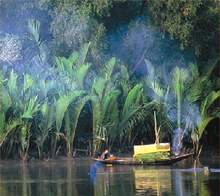 Sundarban, the largest mangrove in the world, is located in the southwest region of the country, on the border between India and Bangladesh. Sundarban, the largest mangrove in the world, is located in the southwest region of the country, on the border between India and Bangladesh.The main direct cause of destruction is gas and oil prospection and exploitation by multinational companies whose activities are being favoured by the government itself under the name of development. The so-called Sundarbans Bio Diversity Project, designed to restore the original ecosystem and funded by the Asian Development Bank (ADB), the Global Environment Facility (GEF), and the Nordic Development Fund, is being strongly criticised by IEDS (Friends of the Earth-Bangladesh) because of the infrastructures for ecotourism built in the heart of the mangrove and the non-transparent way in which the whole project is being implemented, disregarding the viewpoints and interests of local communities. Even though to the official and the development agencies viewpoint, population pressure is the only cause for forest destruction in Bangladesh, reality shows that unsustainable "development" and infrastructure projects, coupled with poor performance of the authorities regarding forest conservation constitute the most important, causes of deforestation and forest degradation in the country (A. Baten, 2004). |
2. THE LOSS OF BIODIVERSITY
In Bangladesh the size of undisturbed areas, ecologically important forest and natural elements has almost disappeared since the beginning of the century. In 1793 the permanent settlement law introduced by the British altered agrarian Bengal from a traditional self-contained, motionless, egalitarian society to a new class of landlords. From the middle of nineteenth century the farmers are pushed to grow cash crops like indigo, jute that increasingly replaced homestead forestry. The tea plantation in the north eastern part of Bangladesh correspondingly reduced tropical evergreen and semi-evergreen forests. The rapid loss of biodiversity is accelerated by the present practice of agriculture, structural measures, fishery, forestry and river and ocean pollution.
2.1 AGRICULTURE
Import of Chemical-based Agriculture India currently uses about 5 million tonnes of fertiliser, around 12 000 tonnes of pesticides and manufactures 55 varieties of pesticide, of which DDT, BHC and malathion account for half of the output (Verghese, 1990). In Bangladesh during 1979-80 total use of pesticides was nearly 2,3047 tonnes, whereas the use rose during 1984-85 to nearly 4,000 tonnes, during 1989-90 to more than 5,000 tonnes and during 1992-93 about 7,200 tonnes. This rapidly increase trend on use of pesticides is alarming, allowed to continue, by 1995-96 pesticide use could reach nearly 16000 tonnes (Ramaswamy, FAO, 1992). Besides ,indiscriminate and excessive use of pesticides in increasing amount are posing greatest threat to surface water pollution in the Ganges-Brahmaputra delta plain. DDT and other highly toxic pesticides (Dirty Dozen) are indiscriminately used by the farming community. The Daily Star on 28.02. 95 reports:
The fertility of soil in northern region of the country has been decreasing day by day due to extensive use of chemical fertilisers and banned harmful smuggled Indian pesticides (UNB report).... For the indiscriminate use of these banned pesticides, paddy leaves become discolour. Besides, it kills frogs, fish and other insects which are helpful for crop production.
In 1992 toxic fertilisers
containing a high amount of cadmium, lead etc. imported from the USA and
distributed in 12 districts of Bangladesh. The developed countries, pressed
by their mountains of waste and increasing disposal costs, began to look
for opportunities to export the problem.
Monocropping
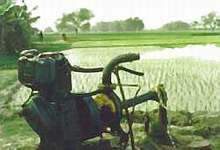 In Bangladesh total production of rice (Aus, Aman, and Boro) and wheat
increased from 9.9 million tonnes in 1972/73 to 19.1 million tonnes in
1990/91. This has been achieved through extensive cultivation of HYVs
(High Yield Varieties) of rice and wheat with extensive use of fertilisers,
pesticides and irrigation. In fact, the growth rates in rice have been
showing a down-turn for the last four years. Prof A. Bayes reports during
the most recent period (1990/91 - 1993/94) trend growth rate of total
rice production is estimated at 0.4 per cent - this compares compares
much lower with the preceding (1984/85 - 1989/90) period's estimated growth
rate of 3.1 per cent (Daily Star, Feb. 18, 1995). It may be mentioned
that Bangladesh's ratio of crop land to population is no worse than Germany
or China, and much better than those of Taiwan and South Korea - yet its
average rice yields are less than half of the later two countries.
In Bangladesh total production of rice (Aus, Aman, and Boro) and wheat
increased from 9.9 million tonnes in 1972/73 to 19.1 million tonnes in
1990/91. This has been achieved through extensive cultivation of HYVs
(High Yield Varieties) of rice and wheat with extensive use of fertilisers,
pesticides and irrigation. In fact, the growth rates in rice have been
showing a down-turn for the last four years. Prof A. Bayes reports during
the most recent period (1990/91 - 1993/94) trend growth rate of total
rice production is estimated at 0.4 per cent - this compares compares
much lower with the preceding (1984/85 - 1989/90) period's estimated growth
rate of 3.1 per cent (Daily Star, Feb. 18, 1995). It may be mentioned
that Bangladesh's ratio of crop land to population is no worse than Germany
or China, and much better than those of Taiwan and South Korea - yet its
average rice yields are less than half of the later two countries.
The traditional varieties of rice such as Aman, Boro, Aus etc. are replaced
in many areas by HYV. At present the farmers complains that a declining
yield of HYV rice despite increasing use of chemical fertilisers and pesticides.
Year round mono-cropping resulted in Bangladesh depletion of soil nutrients,
formation of toxic compounds in soil and about 1.74 million ha land is
deficient in essential nutrients (sulphur, zinc). This has caused 10 per
cent crop reduction, 17 per cent for rice crop (Ministry of Environment
and Forest, 1991).
Deterioration of Soil
The Government and many Organisation in Bangladesh reported that the deterioration
in soil fertility is attributed to continuous monocropping of rice, particularly
HYV rice. The daily "Bhorer Kagag" reports on November 11, 1994
almost all HYV rice fields in the southern districts of Bangladesh are
severely destroyed by the insects, whereas 16 districts of the northern
part of Bangladesh seriously lacking of essential trace minerals (crop
production will reduce to 40-50 % within the next three to four years).
Genetic Erosion
There were about 30,000 rice varieties cultivated by farmers in the Indian-Subcontinent
and at present only 15 varieties comprise 75 percent of rice cultivation.
Monoculture creates a market for crop chemicals. More advanced varieties
of seed will lead to more toxic chemicals, greater risk for farmers, achieves
only more environmental damage. Pat Mooney and Cary Fowler, the Noble
Prize winners of 1985, described it as "genetic erosion", most
prominent of all is the environmental erosion.
2.2. STRUCTURAL MEASURES
After the construction embankments, where the HYV cultivated, agricultural
land does not receive fresh fertile sediments, algae and water that keep
ground water level high during dry season, depleting natural soil to nutrient
poor soil. The loss of vital nutrients like illite, montmorillonite clay
minerals, silt, organic matters (nitrogen supplying algae) are compensated
by chemical fertilisers. The environmental aspects of surface water development
projects have been neglected by the planners and engineers. In the planning
of projects farmers requirements and knowledge are not considered. Mainly
engineers' decisions and designs are imposed on them (Khan, 1987).
For example under the Ganges-Kobadak Irrigation Project construction of
flood embankments produced flowing rivers like Kumar, Kaliganga and Dakua
to dead rivers which created a serious ecological disaster. Another example
of ecological disaster is Horai River Sub-Project where in February 1989
the inlet of the Horai River at the Padma (Ganges) end closed down which
resulted 20 beels (wetlands) of 9,000 acres dried up. Besides the loss
of wetland prevented the annual recruitment of fish prawn and nutrient
rich water from the Padma (Ganges) river. If the current trend continues,
in twenty years about 2 million ha flood plains would have been permanently
removed due to flood control and drainage development (Ministry of Environment
and Forest, 1991). After China and India Bangladesh is the third largest
country in the world in inland fisheries. But at present the average yields
for inland fishery are low and declining by about 2.7 per cent a year.
However, this decline have been offset by increased inland culture fisheries
by the richer group of rural population. But the poorer group of the rural
population (more than 80 per cent) who used to catch fish from the floodplains
as the only source of animal protein is interrupted from this source due
to structural measures and increasing surface water pollution. In 1960
average caloric intake in Bangladesh was more than 2,300 which reduced
to 1,920 in year 1990. A large number of children in poor families become
blind every year because of nonavailability of proper diet.
Farakka Barrage
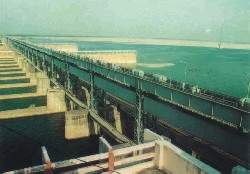 The dry season flow of the Ganges is also reduced in Bangladesh due to
upstream water diversions by India. Shortage of water in the dry season
in Bangladesh is exacerbated by the diversion of water at the Farakka
barrage, just upstream of where the Ganges enters Bangladesh . The actual
allocation of Ganges water at Farakka (India) has been causing serious
concern to Bangladesh due to the reduced availability during dry season
causing excessive siltation, elevation of the bed levels and consequent
reduction in the flood discharging capacity of the channels, shifting
of the Ganges thereby blockage of the Gorai River off take - resulting
in decreased ground water level and increase salinity and alkalinity.
Millions of farmers and fishermen in Bangladesh are displaced from their
occupation due to shortage of fresh water during dry season.
The dry season flow of the Ganges is also reduced in Bangladesh due to
upstream water diversions by India. Shortage of water in the dry season
in Bangladesh is exacerbated by the diversion of water at the Farakka
barrage, just upstream of where the Ganges enters Bangladesh . The actual
allocation of Ganges water at Farakka (India) has been causing serious
concern to Bangladesh due to the reduced availability during dry season
causing excessive siltation, elevation of the bed levels and consequent
reduction in the flood discharging capacity of the channels, shifting
of the Ganges thereby blockage of the Gorai River off take - resulting
in decreased ground water level and increase salinity and alkalinity.
Millions of farmers and fishermen in Bangladesh are displaced from their
occupation due to shortage of fresh water during dry season.
 Freshwater runoff
influence on the annual cycle of phytoplankton production and biomass.
Most of the primary production in coastal waters is due to phytoplankton
which is adverted from one place to the other with currents, as the plants
grow and multiply. Most important commercial fish species have plankton
larvae and as they grow, their cruising speed and migration distance usually
increases. Natural or man-made alternations of the pattern of freshwater
discharge into the marine system are of great concern because of the potential
impact of such alternations on the marine biota and particularly on the
commercially exploited species (e.g. Neu, 1976 and Skreslet, 1976 and
Therriault et al., 1986). River plumes overlying the shelf invariably
support higher production and carry higher pelagic biomass than neighbouring
coastal waters.
Freshwater runoff
influence on the annual cycle of phytoplankton production and biomass.
Most of the primary production in coastal waters is due to phytoplankton
which is adverted from one place to the other with currents, as the plants
grow and multiply. Most important commercial fish species have plankton
larvae and as they grow, their cruising speed and migration distance usually
increases. Natural or man-made alternations of the pattern of freshwater
discharge into the marine system are of great concern because of the potential
impact of such alternations on the marine biota and particularly on the
commercially exploited species (e.g. Neu, 1976 and Skreslet, 1976 and
Therriault et al., 1986). River plumes overlying the shelf invariably
support higher production and carry higher pelagic biomass than neighbouring
coastal waters.
The case of the Nile plume is the most striking example of how river regulation can affect the ecology of the receiving basin. Before erection of the High Dam, massive diatom blooms that grew on nutrients introduced by the Nile occurred in the river plume in autumn - the season of maximum runoff (Dowler, 1984). The annual zooplankton maximum also coincided with this bloom. A large sardine population used to appear during this season to feed in the plume. During the period when the reservoir was being filled (1966-77) the sardine catch dropped to extremely low levels. After the construction of Farakka Barrage on the river Ganges by India the ecology of Bangladesh has drastically changed.
The White Paper on
the Ganges water dispute, published by the Government of Bangladesh (1976)
describes:
A grave crisis has arisen for Bangladesh on account of India's unilateral
action in diverting the waters of the Ganges at Farakka...The most devastating
effect of the Ganges water has been generated from the marked increase
in salinity, both intrusion and soil moisture depletion occasioned by
the depletion of groundwater table..... The reduced water availability
significantly reduced the landing of fish probably because of the disturbance
of the historic food chain and inability of the fish to tolerate shallow
depths and the unprecedented levels of salinity. At three key landing
points, namely, Khulna, Goalando and Chandpur, the percentage of reduction
in the landing of fish during February to June 1976 compared to the corresponding
period of 1975 was 75%, 34% and 46% respectively.
The production of hand-crafted muslin textiles flowered under state patronage
and it became the main source of wealth and prosperity for the city. Even
after the independence nothing has changed. Only from 1974 to 1981 the
population of Dhaka city increased by 200 per cent, unlike other developing
countries this influx was not accompanied by industrialisation, but due
increase of more landless peasants. The present economic development increasingly widens the gap between the
poor and the rich. The limited agricultural land does not allow any further
expansion along with the fast expanding population of working age. In
view of this problem the Government of Bangladesh is planning for a rapid
increase in industry, commerce and services (55.7 per cent of GDP). At
present industrial manufacturing accounts for about 10 per cent of GDP
in Bangladesh and 10 per cent of total employment, and contributes about
three-quarters of total merchandise exports. The earliest industries in
Bangladesh were based primarily on agricultural products like jute, sugarcane,
tobacco, forest raw materials, and hides and skins. During the mid-sixties
a modern industrial base emerged as heavy industries like steel, machine
tools, electric machines, diesel plants, refineries, pharmaceutical plants
and other chemical industries were set up. From 1985 to 1990 the industrial
sector achieved an average annual rate of growth of 4.02 per cent. In
recent years, the major source of industrial growth has been in textiles,
with ready-made garment manufacture expanding from insignificance in the
1970s to the leading export earner today. Leather tanning and brackish
water shrimp farming have also expanded rapidly and are expected to grow
further.
2.3. FISHERIES
Inland water fisheries accounts for more than 70 percent of the total
fish catch but the price hike and nonavilability of many variety of fish
types indicate a decline of inland fisheries. In Kushtia district reports
Daily Star ( Feb. 28, 1995) at least 50,000 of different thanas are living
under poverty line due to proper patronisation, unplanned construction
of embankment, lack of capital, non-ultisation of haros (wetlands) and
rivers and adverse effect of the Farakka Barrage. On the other hand, the
existing waterbodies are leased out to the influential non-professionals
depriving genuine traditional fishermen. The same trend is repeated all
over the country.
Shrimp Export
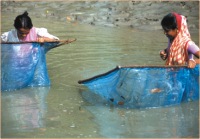 On the other hand, marine fisheries, particularly shrimp for export is
growing 8 per cent a year, which is at the cost of mangrove forests in
the coastal region of Bangladesh. For example, the Chakria Sunderban in
the coastal area of Bangladesh has proved to protect the lives and properties
of the people of Chakria during past severe cyclones and tidal surges.
If the present land use practice continues, the forest will disappear
very soon, and once the forest disappears the productivity of fish and
other habitat will decrease beyond economic return. There is a rapid increase
in land use for shrimp farming - 1983-84 about 40,835 ha and it is expected
in the year 2005 about 110,048 to 135,030 ha land will be occupied by
shrimp farming. Only the rich and influential persons from the cities
are involve in shrimp farming, whereas farmers are deprived of financial
and technical know-how and evicted from their land which creating an increase
in landless peasants. Some critics compare it the same method of indigo
plantation under the British rule. At present (1995) there is a drastic
decline in fish in the coastal region of Bangladesh. Bangladesh could
gain a third of its present physical size, if natural mangrove forests
were allowed to grow in the Ganges-Brahmaputra-Meghna delta mouth during
the last century.
On the other hand, marine fisheries, particularly shrimp for export is
growing 8 per cent a year, which is at the cost of mangrove forests in
the coastal region of Bangladesh. For example, the Chakria Sunderban in
the coastal area of Bangladesh has proved to protect the lives and properties
of the people of Chakria during past severe cyclones and tidal surges.
If the present land use practice continues, the forest will disappear
very soon, and once the forest disappears the productivity of fish and
other habitat will decrease beyond economic return. There is a rapid increase
in land use for shrimp farming - 1983-84 about 40,835 ha and it is expected
in the year 2005 about 110,048 to 135,030 ha land will be occupied by
shrimp farming. Only the rich and influential persons from the cities
are involve in shrimp farming, whereas farmers are deprived of financial
and technical know-how and evicted from their land which creating an increase
in landless peasants. Some critics compare it the same method of indigo
plantation under the British rule. At present (1995) there is a drastic
decline in fish in the coastal region of Bangladesh. Bangladesh could
gain a third of its present physical size, if natural mangrove forests
were allowed to grow in the Ganges-Brahmaputra-Meghna delta mouth during
the last century.
Shrimps produced in this area do not come to the local markets, but arrive
in exotic kitchens of the industrial countries.
Frog Legs Export
During the years 1982-83 Bangladesh exported 4.14 million lb. of frog
legs worth 119.8 million Taka (app. 40 Tk.=1 US $), and which increased
to 5.97 million lb. and earned 424.2 million Tk. Bangladeshis do not eat
frog legs but these are exported for the exquisite kitchens of the industrial
countries (Dept. of Environment, 1989). The method of killing a frog is
beyond description, only the legs are amputated, and the frog suffers
an endless circle of death and life before it can die at last. A huge
loss of natural frogs in the floodplain will be compensated by the use
of more pesticides.
2.4. INDUSTRIES
During 17 Th. century Dhaka city began to develop as a cultural, political,
industrial and commercial centre of the north-eastern part of India. Many
reliable documents suggests that throughout the seventeenth and three-quarters
of the eighteenth century centuries, the wealth and prosperity of the
city advanced at a cumulative rate.
Import of Industrial Product and industry from the North
The present economic development increasingly widens the gap between the
poor and the rich. With the introduction of chemical fibre and plastic
bags in the industrial countries jute and jute products declined in importance
by nearly 50 per cent between 1981 and 1988 - from 70 per cent to 31 per
cent of total exports.
Polluted Industries: Hazaribagh Leather Industry
The annual supply of hides and skins in Bangladesh is estimated to be
about 13.95 million square meters. Only 15-18 per cent of the total supply
is needed to meet the domestic requirements and the rest about 11.81 million
square meters remains surplus for export.
The small leather industry of Indian-subcontinent developed Indian vegetable
tanned crust over a hundred years ago to preserve the hide in the safest
way to suit Indian conditions. The development of leather processing industry
was started in Bangladesh in the late 1940s. Until mid 1960s, the leather
was dominated by vegetable tannage for supply to W. Pakistan, Iran and
Turkey. Manufacture of wet blue, the chrome tanned semiprocessed leather
started featuring in 1965. There was a rapid growth of tanning industry
in Bangladesh during 1970s and by the end of 70s. Until 1980-81, the export
from leather sector was almost 100% in the form of wet blue, the chrome
tanned semi-processed leather .
The operation in tanning which give rise effluents may be categorised
into pre-tanning and post-tanning processes. Pre-tanning is employed mainly
for the removal of impurities from the raw materials. These consist largely
of protein (blood, hair, etc.) and the process chemicals employed include
salts, lime and sulphides. The tanning processes themselves are used to
alter the characteristics of skin or hide and their effluents contain
chromium and vegetable or synthetic tanning. Post-tanning process include
coloration and produce effluents typical of these addition processes;
that is, containing residues of dyestuffs or pigments and larger quantities
of auxiliary chemicals.
The process chemicals employed are a variety of
inorganic and organic materials, affecting total solids, pH, COD and of
particular importance are the applicable quantities of sulphide and of
heavy metals. Hazardous chemicals for leather and dyes treatments are
Ammonium Bicarbonate, Chromic Acetate, Ethylene Glycol Monoethyl Ether,
Methylamine, o-Nitrophenol, Toulene Diamine, 2,4,5-Trichlorphenol, Zinc
Hydrosulfite, Zinc Sulphate, tert-Butylamine, Cadmium Nitrate, Cadmium
(II) Acetate, Copper(2)Nitrate, 1,4-1,8 Dichloronaphthalene, Nickel Sulphate,
o-Xylene, Zinc Nitrate etc.170 tanneries of Hazaribagh generates waste
water about 5,000 litres/100 kg of hides and skins. Buriganga river is
highly contaminated with pollutans and tubewells for drinking water adjacent
to the down-gradient from the Hazaribagh industrial area is highly polluted.
The small cottage tanners of Hazaribagh producing sandal leather out of
cow heads are probably the only tanning group in the world using waste
tanning liquor from the modern tanners as their process liquor. But after
using these waste are eventually discharged, as are all other tannery
discharges in the Hazaribagh tanning effluents into the streets, gutters
and sewers which ultimately enter surface and ground water.
According
to Dittfurth and Röhring (1987) about 250 different toxic chemicals
and heavy metals like cadmium, chromium, arsenic, zinc etc. are used by
the leather industry. When the local industry was basically a vegetable
tanning complex, this effluent might have been high in BOD and unpleasant
but not particularly dangerous.
Unplanned Industries
With the increase of unplanned and socially and environmentally degraded
industries Bangladesh poses a new challenge. Pollution and human-induced
hazards are particularly serious in the developing nations, because industrial
production is heavily concentrated in one or two city regions or 'core
regions' within each nation. The industrial areas in Bangladesh are situated
in the midst of densely populated regions. There are many hazardous and
potentially dangerous polluting industries situated in the cities of Bangladesh.
In Dhaka at Tejgaon area, food processing industries are situated along
with chemical and heavy metal processing industries. In Tongi a pharmaceutical
industry is situated near a pesticide producing industry. Tannery industries
of Hazaribagh also situated in a heavily populated residential area. These
examples are repeated in the cities of Chittagong, Khulna and other smaller
cities of Bangladesh. The Government of Bangladesh has not shown much
interest in environmental impact created by the industries, whereas government's
concern to create jobs usually meant that when a new factory is proposed
- by local, national or international business or agency - little attention
is given to the likely environmental impacts.
2. 5. FORESTRY
 Most of Bangladesh was originally forested, with coastal mangroves backed
by swamp forests and a broad plain of tropical moist deciduous forest
(IUCN, 1987). However, most of the original vegetation has been cleared.
The hills of Chittagong and Syleht were once covered by tropical evergreen
and semi-evergreen rain forests ( FAO/UNEP, 1981). Remnants of these forests
are found in the eastern part of the country. The annual rate of deforestation
is 80 sq.km. (FAO, 1986). The origin of current crisis lies in the short-sighted
forest policies initiated by the British, and even after independence,
the same commercial outlook has remained the dominant theme within the
forest departments. Unregulated commercial exploitation, big development
projects and resulting poverty are the main reasons for deforestation.
Most of Bangladesh was originally forested, with coastal mangroves backed
by swamp forests and a broad plain of tropical moist deciduous forest
(IUCN, 1987). However, most of the original vegetation has been cleared.
The hills of Chittagong and Syleht were once covered by tropical evergreen
and semi-evergreen rain forests ( FAO/UNEP, 1981). Remnants of these forests
are found in the eastern part of the country. The annual rate of deforestation
is 80 sq.km. (FAO, 1986). The origin of current crisis lies in the short-sighted
forest policies initiated by the British, and even after independence,
the same commercial outlook has remained the dominant theme within the
forest departments. Unregulated commercial exploitation, big development
projects and resulting poverty are the main reasons for deforestation.
Sunderbans, the largest mangrove forests of the world, was once covered all along the coastal plain of Bangladesh. Had it been maintained, the Bay of Bengal would have turned into one of the largest fish grounds of the world, gained land one third to the present size of Bangladesh, and have protected millions of lives during cyclone storms.
Sunderbans in the eastern coastal region of Bangladesh is still the largest mangrove forest of the world threatened - 18 species of animals are reported have been lost in this century, 130 are endangered and there are also over 300 species listed are rare and doubtful of occurrence, 40 to 45 percent of declined in sundari and gewa plants has occurred between 1958-59 and 1983 (1983 ODA Survey). About 50 per cent of the original mangrove area has been deforested and converted to polders (Karim, 1995). Chakria Sunderbans in the eastern part of Bangladesh is almost disappeared with the intensive increase of shrimp and fin-fish culture farms for the exotic kitchens of industrial countries.
AFFORESTATION PROGRAMME
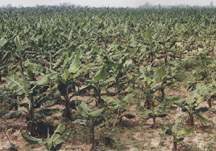 The ADB (Asian Development
Bank) funded afforestation programme in the Modhupur (16,000 ha woodlots
in Gazipur, Tangail, Sherpur, Commila, Mymensingh, Dinajpur, Rajshahi,
and Rangpur), north east of Dhaka and the third largest forest of Bangladesh,
where the last standing natural trees are rapidly disappearing, come under
criticism (Society for Environment and Human Development (SEDH), 1993).
The ADB (Asian Development
Bank) funded afforestation programme in the Modhupur (16,000 ha woodlots
in Gazipur, Tangail, Sherpur, Commila, Mymensingh, Dinajpur, Rajshahi,
and Rangpur), north east of Dhaka and the third largest forest of Bangladesh,
where the last standing natural trees are rapidly disappearing, come under
criticism (Society for Environment and Human Development (SEDH), 1993).
ADB project designed primarily to increase the production of biomass fuels and enhance the institutional capacity of the Forest Department and the thana administrations in implementing a self-sustaining nation-wide social forestry. According to the appraisal report, the most common exotic species selected for woodlot plantations include Eucalyptus spp.,Dalbergia Sisso, Leucaena leucocephla, Swietenia macrophulla, and Leucocedepha swieternia. The ADB claims that the exotic species selected for woodlot are well adopted to tropical conditions with high rainfall and with the adequate combination of nitrogen-fixing understory vegetation and soil treatment can be planted without fear. But past plantations show all negative results. The exotic species grow faster than the natural trees, so they can replace the natural Sal or other local species. This view has been rejected by the local people who are aware of the long-term benefits of natural Sal or other trees, because the natural trees are so diversified that they not only supply timber and fuelwood, but also medical plants and habitat for rare wildlife. The Garo tribals recently complain (1993):
In the first place, the Forest Department is attempting to take our lands which we have cultivated for generations. In the second place, we do not trust the Forest Department. We are the witnesses of how the corrupt elements in the Forest Department have destroyed the forest in collusion with the business interest. What we have seen in the past few years is incredible. When the Forest Department decides to establish a woodlot block, it just comes with hired labourer, they start cutting the coppies of Sal (Shorea robusta) and within a few weeks, all coppies are cleared. This is ecocide caused by the Forest Department. and this is how the Forest Department degrades or denudes the forest land for the preparation of woodlock. We, the forest people, are so accustomed to forest life that we cannot survive without natural forest, and we will be gradually evicted from the forest land as woodlot plantations are replacing the natural forests... We grow rice, pineapples and other crops on our croplands, but we never destroy natural forest. Because we know that natural forest is very significant and much more beneficial than the forest established with exotic species (imported varieties).
"Social Forestry Programme" has turned out to be little more
than an extension of earlier forestry practices and it has failed to achieve
its goal.
2.6. RIVER POLLUTION
The Ganges-Brahmaputra delta is the largest delta in the world and the rivers contribute one-third of the global sediment transport to the world oceans. The rivers flow through 10 per cent global population and carry untreated rural, urban, municipal, and industrial wastes to the Bay of Bengal. India ranking the tenth largest industrial country of the world but most industrial plants use outdated and polluting technologies. The river Ganges flows through more than 700 cities and about 120 million litres of waste water added daily. DDT factories, tanneries, paper and pulp mills, petrochemicals and fertiliser complexes, rubber factories and host of others use river to get rid of their waste. 70 per cent of surface water in India is polluted. About 6,000 large and medium industries and 24,000 small industries are operating in Bangladesh discharge untreated effluents (10 to 100 times the allowable levels permissible for human health) directly to the rivers without any regard to environment. All of Bangladesh's sewage is flushed directly into Ganges and Brahmaputra Rivers. The categories of wastes create water pollution are as follows:
Liquid Inorganic wastes:
Most of the inorganic liquid wastes come from industry, and their dilution in large river waters renders them harmless. Some inorganic toxic wastes can become concentrated up the food chain to fish. Many of the pollution incidents which have been resulted in many parts of the world in largest number of deaths and serious injuries from water pollution have been arisen from human ingestion of fish, or crops contaminated with heavy metals or other inorganic compounds.
Liquid Organic Wastes:
Wastes when disposed of in water, bacteria and other micro-organisms combine with oxygen dissolved in water to break them down, can be termed as "oxygen demanding" wastes. Liquid organic wastes include sewage, many wastes from industries (especially industries producing agricultural and tannery products) and run-off from rains, floods and storms which picks up organic wastes from land, before flowing into streams, rivers, lakes or seas. As concentration of dissolved oxygen decreases, so fish and aquatic plant life suffer or die. According to Department of Environment, Government of Bangladesh (1988), Karnaphuli River shows following intolerable BOD values: at Kalurghat (tannery and food processing industrial area) 800 - 12,000 ppm, at Chandragahna (paper mill) 60 ppm. Industrial wastes also creates a very high chemical oxygen demand (COD) ranges between 75-600 mg/l. Besides, Buriganga River near Dhaka shows BOD between 5-75 mg/l. A wide spread of fish deaths have occurred in these areas, and thousands of fishermen have lost their jobs. In Damodar river, near Calcutta BOD level rises upto 30 mg/l (Rao, et al., 1991).
Waterborne or related pathogens:
Many pathogens (disease causing agents including bacteria, viruses and worms) are spread in water - either through human ingestion of contaminated water or because water provides the habitat for intermediate hosts. Outbreak of floods in Bangladesh causes disease epidemics of dysentery and other waterborne and water-washed diseases, as floods contaminate all available water supplies.
3. DISCUSSION
Increase chemical based agriculture and destruction of natural environments due to structural measures in this subcontinent pose the greatest threat of surface and ground water contamination. A rapid disappearance of forests, coastal mangrove forests and wetlands is increasingly lacking in natural purification of polluted waters. The point and non-point sources of surface water pollution are creating chemical and biological contamination, channel contamination and basin contamination and the existing management efforts are incapable to meet the problems. The loss of genetic diversity may further lead to an explosive rise in the number of species becoming extinct. The loss of diversity crops, flora and fauna is a potential threat in Bangladesh to the food production. Although the economy of the country completely rely on the renewable resources policies in Bangladesh Government plans are conspicuous by their absence and where they exist they are inadequate, outdated or unforceful. Even the aid giving agencies are engaged in short-term return projects - give no consideration to country's traditional wisdom.
Regulating access to genetic resources or conservation of biodiversity
Regulating access to genetic resources or conservation of biodiversity is a local, regional and global problem. The richest 25 per cent of the world population has historically consumed between 60 to 80 per cent of all the major minerals and resources. Over the past century, their economies have pumped out two-thirds of the greenhouse gases that threaten the planet's climate. Their industries generate 70 per cent of world's industrial waste and most of the world's hazardous chemical wastes. Industrial economics today cause ecological degradation both by depleting the resource base of both agriculture and industry, and by poisoning the system with pollutants. The developing countries so far followed strategies that are modelled after the experience of industrialisation of the developed societies.The national accounting system reports "growth" in GNP per capita, in fact, the "growth" is primarily in those sectors of the economy that are better labelled as "costs" ( unpaid costs to Mother Nature) than "benefits". Much of the "well-being" of the North has been attained through the direct transfer of natural resources from the South. Elite of most nations holds similar western ideas about society, about nature, and about the consequent future direction of the planet. We do not seriously seek for a change in our society, where economic and social values can improve the situation of the majority of the population.
It is often argued that a rapid population growth is responsible for the loss of biodiversity in Bangladesh. Bangladesh's population was virtually stationary for two thousand years preceding the establishment of British rule (Advise, 1951). But in last one hundred years, population in Bangladesh quadrupled - increasing 26.8 million in 1891 to 111.4 million on 11 March 1991 (BBS, 1994). Inspite of spending millions of dollars the growth rate is still 2.17 per cent, whereas population below 24 years age is 62.26 per cent (1991 census). A recent historical analysis of demographic change in fourteen countries - ranging from the United States across Europe to Russia - shows that the decline of birth rate began in conjunction with freedom from economic and political repression (Clark, 1989).
At present the direct sufferers of biodiversity loss are the poors that is the majority of 110 million population. The existing projects mainly concern for the betterment of a privileged section of the population, whereas the poor continue to be the enemy, misunderstood and blamed for circumstances beyond their control. Development policy in Bangladesh has emphasised urban-based, modern-sector industrial development at the expense of the rural majority; indeed, sector budget allocations to agriculture and rural development have steadily declined since 1974 (Norwegian Aid Review, 1986). The per capita expenditure on education in Bangladesh is one of the lowest in the world. In 1992-93 national accounts expenditure for agriculture sector was only 4409 million Taka, whereas on defence sector it was 14960 million Taka (BBS, 1994). Besides since 1975 the military budget was revised upwards and other funds were channelled for the armed forces through the budget of other ministries - such as Ministry of Roads and highways and Ministry of public Works and Urban Development (Ahmed, 1995).
The Ganges-Brahmaputra Rivers transport annually 2.9 billion tonnes of nutrient rich sediments to the Bay of Bengal and there is no effort in the country to utilise this unique natural gift. Bangladesh urgently needs to develop improve farming techniques for traditional varieties under regulated flash of annual nutrient-rich flood waters in the agricultural land and reducing reliance on chemicals and this will lead to conservation of biodiversity.
Our cultural patterns have been disrupted and our societies have become unstable.. Since twenty years Bangladesh has received about 22 billion US dollars, where 75 per cent of the amount immediately returned to the aid giving countries as expert fees and equipment purchase. Prof. Yunus, founder of Grammen Bank, comments that the situation of the poor has not at all improved, whereas the projects kept poverty to continue. Since independence aid giving organisations and NGOs are working to eliminate poverty in the country. When they initiated the programme the landless peasants were 37 per cent and now according to a Government report it is 58 per cent.now. Whereas an official source reports uneducated persons are increasing to 5,000 each day. 30 per cent of the population (about 2 million) of Dhaka in recent years live in more than 1500 slums and squatter settlement situated mainly on hazardous waste deposits of previous wetlands.
In Bangladesh the major problems which are undermining resource sustainability are :
Lack of understanding on sustanability
Loss of cultural and social tradition
Government policies are directed from the interest from the North
Assistance programme do not endorse sustainability Short sighted use of resources Low involvement of people in decision making Unrestricted access to resource Transfer of wealth from South to North Land ownership by the wealthy elite.
The Governments of this region have made commitment for a sustainable development or signed the convention on biological diversity, but in practice in collaboration with assistance from the industrial countries the opposite to it is occurring. Governments of this region have announced their commitment to saving tropical forests or convention on biological diversity, while handling out logging concession to their supporters. Land reclamation projects in the coastal area of Bangladesh are recommended to grow diverse mangrove forests as an important aspect of economic growth and cyclone protection, but these newly emerged land are occupied or indirectly owned by the big land owners or influential quarters who have a strong lobby in each type of government, parliament, police and forest department. Shrimp farming in the coastal regions of Bangladesh mainly occupied by the rich and influential persons from the cities and the rural poors are increasingly evicted from their lands. A former law minister writes (Ahmed , 1995):
To visit a jail is also to discover that nearly all prisoners are very poor. The visitor will soon come to realise that they are in prison only because they are poor. They have no one to fall back on in society., no means to go to court and, with no legal aid for them, they cannot even apply for bail.....The prisoners live in inhuman conditions, treated as slaves, fed as animals...... After being in jail for long as five years, the prisoner may be given a conviction of two years, with the result that he serves seven years altogether.... The crisis in the system of justice has now engulfed the nation leading to a loss confidence in the system as a whole.
On. August 26, 1995 a young girl of about age 14 years in Dinajpur was raped before being murdered by the policemen who took her into their van ostensibly to help her reach home. The angry people of Dinajpur town, while demonstrating in front of the local police station, came under attack when police opened fire, killing seven persons and injuring more than 100... The fearful aspect, one that has established a continuity in our history, is the role of law enforcement agencies in breaking the law (Courier, 8 Sept., 1995).While international organisations are arranging many seminars, workshops or agreements to improve the living quality of the developing countries, may be somewhat useful but they are missing the main target. By seeing only we wish to see, by supposing we know far more than we do, we are ignoring the multiple signals of social, psychic, and environmental deterioration that constantly increase.
Material consumption, money, and all other economic matters are the central focus of society and the sole measure of its progress. Technological advances have replaced co-operation by competition as the idealised form of human behaviour. In our society a small economically powerful elite controls the political process and the majority are persuaded to follow from a combination of mainly ideological and material reason. The elite of most nation hold similar Western ideas about Society, about Nature, and about consequent future direction of the planet. In Bangladesh the benefits of democracy seem to reach only city-based elite groups and vested interests, leaving the silent majority outside the magic ring (Ahmed, 1995).
Our ideas and decision come from the city, and rarely filter down to villages. what we need to see happening is reversal - an ecological sensibility that starts at the village level. Bangladesh requires a corruption-free administration, land reform to eliminate increasingly growing landless peasants and migration of population in the slums, pollution prevention and sustainable development incentives in the rural areas, an education system understandable to rural population based on their wisdom and traditional egalitarian social dynamics, and a sustainable economy based on country's real requirements. Resources belong to everyone - or at least everyone has the right of access to them - and they are allocated according to an agreed system of rules and traditions.'Development' means not copying the West's high-technology, highly centralised societies, but instead developing participatory, co-operative societies where local people control the allocation and use of their resources and decides what technological innovations are appropriate and what economic arrangements are acceptable.
To regulate access to genetic resources or conservation of biodiversity requires:
There is enough for everyone's need, but not for everyone's greed (Mahatma Gandhi). Societies in the past understood about their relations with soil, air and water of Earth. N. Scott Momaday, a Kiowa Indian spoke the following words (Capra ,1982):
You say that I use the land and I reply, yes, it is true; but it is not the first truth. The first truth is that I love the land; I see it is beautiful; I delight in it I alive in it.
A shared community is only successful and sustainable, if it can "think" , "feel" and "act" accordingly. In Bangladesh Jasim Uddin writes:
If you take a flower
You have to give
A heart like a flower,
Those who take flower
Give flower in return.
4. REFERENCES
Ahmed, M. (1995): Democracy and the Challenge of Development A study of Politics and Military Intervention in Bangladesh; University Press, Dhaka, Bangladesh.
Ahmed, S. U. (1986): Dacca: A Study in Urban History and Development; Curzon Press Ltd., London.
Allen, B. C. (1912): Dacca: Eastern Bengal District Gazetteers; Pioneer Press, Allahbad.
Anwar, J. (1988): Geology of Coastal Area of Bangladesh for Resource Development and Management; National Workshop on Coastal Area Resource Development and Management; H. J. Moudud et al. ed.,CARDMA, Dhaka, Bangladesh.
Anwar, J.(1991): Coastal Hazards:Bangladesh 1991; The Bangladesh Observer, May 22, 1991, Dhaka.
Anwar, J. (1992): The Ganges Brahmaputra Delta Plain: A Challenge; The Bangladesh Observer, Dhaka.
Anwar, J. (1993): Bangladesh: The State of the Environment; CARDMA, 159 Gulshan Avenue,Dhaka 1212, Bangladesh.
Anwar, J. (1995): Water Pollution in the Ganges Brahmaputra Delta Plain; !995 Pacific Basin Conference on Hazardous Waste - Proceedings; Edmonton, Canada.
Ali, M. L. (1984): Shrimp Farm Survey in the Coastal Area of Bangladesh; Directorate of Fisheries, Govt. of Bangladesh, Dhaka.
BBS (1994): Statistical Pocketbook of bangladesh, 1994; Bangladesh Bureau of Statistics; Dhaka, Bangladesh.
BCAS (1990): Bangladesh environmental News Letter; v2, no 2, Dhaka, Bangladesh.
Capra, F. (1982): A New Vision Of Reality; New Age, February 1982.
CARDMA (1988): Coastal Area Resource development and Management, Part II; National Workshop on Coastal Resource Development and Management, H. J. Moudud et al. ed., Dhaka, Bangladesh.
CARDMA ((1989): The Greenhouse Effect and Coastal Area of Bangladesh;International Conference on Greenhouse Effect, Coastal Area Resource Dev. and Management Association, Dhaka, Bangladesh.
Clark, M. E. (1989): Ariadne's Thread; Macmillan, London.
Clark, M. E. (1993): Changes in Euro-American Values Needed for Sustainability; Journal of Social Issue
Courier (1995): An Independent Newsweekly; Sept 8; 1995; Dhaka, Bangladesh.
Daily Star (1995): Fishermen Facing Manifold Problems in khustia; Feb. 28, 1995, Dhaka, Baangladesh.
Daily Star (1995): Whither the growth Rates in Rice Production, by Prof. Abul Bayes; Feb. 18, 1995, and Feb 28, 1995, Dhaka, Bangladesh.
Davis, K. (1951): The population of India and Pakistan; Princeton University Press, Princeton, USA.
Echelon, E. P. (1976): Losing Ground; W.W. Norton & Comp. Inc., New York.
Greenpeace (1988): Save the Sewage-Toxic pollution Briefing.
Hinrichsen, D. (1990): Our Common Seas; Earthscan Publication Ltd. London.
Hinrichsen, D., ed., (1983): The Indian Ocean; vol. 12, no. 6; Ambio.
Holiday (1995): Weekly Political Review, Editorial, Feb. 27,1995, Dhaka, Bangladesh.
Ittefaque (1995): Begali Daily Newspaper, March 7, 1995, Dhaka, Bangladesh.
Jacobson, J. (1988): Environmental Refugees: A Yardstick of Habitability; paper 86. World Watch Institute, November 1988, Washington DC.
Khan; A. A. (1993): Freshwater Wetlands in Bangladesh; the IUCN Wetland Programme, Gland, Switzerland.
Khan, S. (1987): Folklore of Bangladesh; Bangla Academy, Dhaka, Bangladesh.
Mahmood, N. (1988): Coastal Fisheries and Shrimp Farming of Bangladesh; CARDMA, Dhaka.
Mahmood, N. (1986): Effects of Shrimp Farming and Other Impacts on Mangroves of Bangladesh; IPC Workshop, Bangkok, Thailand.
MacKenzie, D. (1989): If You Can't Treat It, Ship It; New Scientist, 1 April 1989.
Manrique, S. (1976): Travels of Fary Sebastien Manrique - 1629-1643; Vol.1 , Kraus Reprint Ltd, Nendeln, Lichtenstein.
Ministry of Environment anf Forest, Govt. of Bangladesh (1991): Bangladesh Country Report for United Nations Conference on Environment & Development, Brazil 1992, Dhaka, pp114.
Ministry of Environment anf Forest, Govt. of Bangladesh (1989): Environmental Report on Bangladesh; in Bengali, Dhaka, Bangladesh.
Mooney, P. R. (1985): Saat-Multis und Welthunger; Rowohlt, Hamburg, Germany.
Mooney, P. and Fowler, C. (1991): Die Saat des Hungers; Rowohlt, Hamburg, Germany.
Mukhopadhya, S. (1983): History of Bengalis; in Bengali, Puthighar, Dhaka, Bangladesh.
New Scientist (1993): Seeds of dissent in India over foreign 'gene thieves'; Bupesh Mangla, p 8, 31 July, 1993.
O'Leary, J. W. (1970): The Influence of Ground Water salinity on Plant Growth; in Mattox R. B. (ed.) Proceedings of the Symposium on Groundwater Salinity, 46th Annual Meeting of the South-western and Rocky Mountain division of the American Association for the Advancement of Science, Las Vegas, Nevada, USA.
Rahman, A.,Haider, R., Huq, S., and Jansen, E, ed. (1994): Environment and Development in Bangladesh; University Press, Dhaka.
Ramaswamy, S. (1992): Pest Control and Environment; FAO and BARC, Dhaka, Bangladesh.
Rao, N. S. L., and Rao, M. N. (1991): Pollution in Selected Rivers of India - Three Case Studies; in J. Rose ed. Water and Environment,v 3, Gordon & Break Science Publishers, Philadelphia.
Showler, A. (1989): Pesticide Use and Environmental Pollution in Bangladesh; World Resource Institute.
Starke, L. (1990): Signs of Hope - Working Towards Our Common Future, Oxford University Press, Oxford, UK.
Washbrook, D. A. (1988): Progress and problems: south Asian Economic and social History - 1720-1860; modern Asian Studies, V 22, n1.
World Resources Institute, IIED (1987): World Resources 1987.
13. Media workshop told 24 m people at risk of arsenic
contamination
From Our Correspondent, The Daily Star Sun. September 17, 2000
SYLHET, Sept 16: About 24 million people in the country are at the risk of arsenic contamination.
People's awareness is vital to face the risk of the disease. The journalists have a very important role to play for creating the mass awareness in a country like ours, this was viewed at a day long workshop held at a hotel in Sylhet on Saturday.
The division-level media workshop organised by Sylhet Press Club with the assistance of United Nations Children's Fund (UNICEF) was participated by 45 participants from four districts of Sylhet division. Reporters of national dailies, news agencies, regional dailies, weeklies as well as from radio and TV took part in the workshop.
Those who took part in the discussion include the team leader of Arsenic Mitigation Programme, UNICEF, Dhaka, Shafiqul Islam, Communication Officer, Water, Environment and Sanitation section, Shirin Hossain, Communication Officer, Information and Advisory Section, Chinmoy Mutsuddy and Anish Barua, Executive Director of Communica, Dhaka.
The speakers said that arsenic is a kind of substance which is a common part of many minerals and rocks. It occurs naturally in the environment. Arsenic can not be seen, tested or even smelled when it is in water. Symptoms of arsenicosis can range from the development of dark spots on the skin to hardening of the skin into nodules, often on the palms and soles. The World Health Organisation (WHO) estimates that these early symptoms develop after five to 10 years of continued exposure to arsenic and can become more pronounced and in time can develop into cancerious lesions. There is no clear understanding of the impact of small amounts of arsenic on the human body. Some members of a family may be affected while others are not. It is not yet known what the other factors, such as nutrition and prior infection, are significant, the speakers said. There is no known cure for arsenic poisoning, although in its early stages it is a reversible process, especially once the consumption of arsenic contaminated water ceases. Early symptoms, such as skin hardening can also be relieved with simple skin ointments.
The government and many other agencies are now doing tests to find out how much arsenic is in tube-well water. The effects of arsenic poisoning includes discolouration of skin (lightening and darkening), hardening of palms of hands and soles of feet, ulcers, gangrene and cancer. In the prevailing situation, the potential sources of safe water includes treated ground water, treated surface water and rain water, they said.
With reference to the expansion of arsenic contamination in the country, the speakers said that, over 51,000 tube-wells had so far been tested by the Department of Public Health Engineering with the assistance of UNICEF. About 29 per cent of tested tube-wells were found contaminated with arsenic above acceptable limit. About 24 million people in the country are potentially at the risk of developing arsenicosis, with 7,500 cases identified. It showed that, the middle region of the country is affected with the contamination. The greater Sylhet region is also in the affected area, they added. The survey conducted jointly by UNICEF and DPHE gave a picture indicating an expanding situation. The British Geological Survey also says the same situation, they added. Due to the arsenic contamination, the availability of safe water came down to 80 per cent in place of 97 per cent, they informed.
They also informed that UNICEF has been supporting the testing of the tube-wells, provision of alternative water resources, health management, care, and a communication campaign spotting the dangers of arsenic contamination and steps to counter the same.
It is also working in a co-ordinated manner with the inter-ministerial committee on Arsenic Mitigation and the Bangladesh Arsenic Mitigation and Water Supply Project (BAMWSP), supported by World Bank.
Our Netrakona Correspondent reports: People of Netrakona district have become panicky due to increasing arsenic contamination in ground water.
Grabbing the opportunity some NGOs are doing brisk business in the name of examining arsenic contamination in 10 upazilas here.
Unskilled field workers of these NGOs are going house to house and examining water sample from tubewells. They take 50 to 60 taka per tubewell far examining arsenic contamination.
The NGOs are also doing propaganda saying that it is possible to contain arsenic by using medicine.
The NGOs are taking Taka 300 to 400 per tubewell in the name of containing arsenic.
A Non-Governmental Organisation (NGO) is doing work to control arsenic in Kalmakanda upazila by their unskilled field workers, but their examining proved to be wrong most of the time.
Sandha Rani Hajong,a field worker said they took training about controlling arsenic using one kind of medicine.
But the Department of Public Health and Engineering (DPHE), Netrakona sources said, it is impossible to control arsenic by using medicine.
Executive Engineer of Netrakona DPHE told this correspondent that those NGOs are not allowed to test
arsenic contamination by the government. He added that they would take necessary action against these so-called
NGOs who are cheating public in the name of arsenic testing.
Arsenic level in ground water in 47 dists crosses WHO limit, says study
A group of scientists in Jadavpur University in Kolkata have observed that arsenic level in groundwater in 47 districts in Bangladesh and nine district s in Indian West Bengal states have already crossed the World Health Organisation (WHO) maximum permissible limit of 50 micro-gram per litre, reports BSS.
The group, led by head of the School of Environmental Studies (SOES) of Jadavpur University, Dipankar Chakraborti, said the world's four biggest sites of groundwater contamination are Bangladesh, West Bengal of India, Inner Mongolia of the People's Republic of China and Taiwan. They said huge withdrawal of groundwater is taking place because of agricultural irrigation.
"We have made a green revolution at the cost of underground water," a study of the SOES observed.
Exploring the state of the diffusion of available techniques for removal of arsenic from groundwater, the SOES scientists noted that in the villages of India and Bangladesh even a highly successful technology may not succeed unless it fits in the rural context and is accepted by the rural people.
"Development of such technology is only possible when a combination is made between technocrats and villagers with proper village level participation," the scientists said.
They said appropriate arsenic removal technologies should be economically viable and socially acceptable.
The researchers said the processes used in the arsenic-affected areas of Chile and Taiwan at full scale treatment plant is coagulation. But the University of Connecticut (patent pending) has claimed a novel and cost effective Arsenic Remedy Technology (AsRT) for the immobilisation of inorganic arsenic such as arsenates and arsenites.
Quoting field survey reports, they said, in some arsenic-affected villages many families due to high iron content in their tubewell water cannot drink the water directly. To make it drinkable, they just keep the water after withdrawal from tubewell for some time, when a brown precipitate settles at the bottom and the users decant the upper clear water or use a common filter to arrest the flock.
"It is a burning question how and where to dispose of arsenic rich flock. Many thinks that arsenic rich flock if disposed of on soil, may contaminate the aquifer," the scientists said adding that in the laboratory (of SOES) we found that cow-dung can eliminate arsenic in volatile form.
Referring to some tests, the SOES scientists said arsenic removal system of Jadavpur University was proved to be 93 per cent to 98.5 per cent effective according to official test results of Government Industrial Toxicological Research, Lucknow, India, National Test House, India, CSIR institute at Nagpur India as well as independent research conducted by Asia Arsenic Network (AAN), Japan and Thailand bureau of the Asia Arsenic Network.
The AAN (Japan) has purchased 300 units of arsenic removal system from CSIR (Council of Scientific and industrial Research) New Delhi, India and installed them in the arsenic-affected areas across Bangladesh, experts in the SOES said.
The SOES researchers opined that the actual solution of groundwater arsenic contamination in Bangladesh and India would be achieved through proper watershed management utilising the available surface water. (Source: BSS-NEWS 06. 05.2001)
81 pc Bhanga HTW's arsenic affected, Faridpur workshop reveals
15. 81 pc Bhanga HTW's arsenic affected, Faridpur workshop reveals81 pc Bhanga HTW's arsenic affected, Faridpur workshop reveals FARIDPUR, June 8:–A day-long workshop on "Community based arsenic mitigation action research project" jointly organised by Faridpur District Administration and Department of Public Health Engineering in collaboration with UNICEF was held on Wednesday at Faridpur Zila Parishad conference hall, reports BSS. The workshop was organised to review the progress of arsenic mitigation activities in Bhanga Upazila of this district where arsenic problem is very much alarming. According to workshop sources, in Bhanga 91 per cent Hand Tubewell (HTW) is arsenic affected. Out of 21300 HTW, 19127 HTW are arsenic affected and its water consists very high rate of arsenic beyond human consumption.
Dhaka Community Hospital has already identified 488 arsenicosis patients in Bhanga Upazila the sources added. According to a paper presented by the Upazila Nirbahi Officer (UNO) of Bhanga several mitigation committees were formed from Upazila level down to village level for motivational purpose. Dr Shahadat Hossain, UNO, informed that vigorous campaign regarding arsenic problem and mitigation measures have been going on in the area jointly by UNICEF, DPHE, BRAC and Upazila Administration. The UNO from the experience in Bhanga Upazila informed that several options for arsenic free Mater were executed and he suggested Deep Tubewell (DTW) water is the best solution for Bhanga. According to UNO only the water of 103 DTWs functioning in Bhanga is arsenic free. Mr Shafiqul Islam, team leader, arsenic unit of UNICEF also elaborately described the ferocity of arsenic and suggested several options for safe drinking water. These included Pond Sand Filter (PSF), Rain Water Harvesting (RWH), three pot filter and community based arsenic removal plant. (Source, BSS, 2001)
16.US assures of support in fighting the silent havocThe onslaught of arsenic contamination is silent but, nonetheless, it is a disaster that has the potential to poison and kill millions of people in Bangladesh. This distressing fact was disclosed at a three-day symposium titled "Behaviour of Arsenic in Aquifers, Soils and Plants: Implications for Management" held at IDB Bhaban in the city yesterday. It was jointly organised by the International Maize and Wheat Improvement Centre (CIMMYT), Cornell University (CU) of USA, Texas A&M University (TAMU), the United States Geological Survey (USGS) and the Geological Survey of Bangladesh (GSB) with support from USAID.
Speaking as chief guest the US Ambassador to Bangladesh Harry K. Thomas said that Bangladesh was plagued with problems of quality and quantity of water and the problem of arsenic contamination of groundwater stands out. 59 of 64 districts in Bangladesh suffer from various degrees of arsenic contamination and current estimates suggest that 45 to 50 million Bangladeshis, which is 30-35% of the population, may be exposed to drinking water with arsenic concentrations above the admissible limit, he added.
An excess of arsenic in the groundwater not only raises immediate serious public health concerns, but also poses long-term concerns for nutrition and food safety. The problem clearly requires a massive and well-coordinated effort from Bangladesh and its international development partners, the other speakers said. There are no quick fixes to the arsenic problem. The reasons for arsenic contamination in Bangladesh are quite complex, and there are many unanswered questions related to its impacts on health, threats to food supply, and sustainability of various options for arsenic removal or other water supply technologies. To achieve a lasting solution to the arsenic problem, these and other questions will have to be answered. There is a clear need to address this issue from a holistic perspective, as opposed to attacking it with narrow, piecemeal approaches, the speakers observed.
"A number of national and international partners have joined hands together to enhance scientific understanding of this extremely challenging issue and share knowledge with the scientific community, as well as policy-makers, in order to devise future management approaches. This symposium will present a summary of the major studies and findings made by USGS, CIMMYT and their partners. Despite serious efforts from a number of international development partners, it remains extremely challenging to identify pragmatic solutions because of the very complex nature of the problem itself, as well as certain institutional constraints. It is indeed time to take stock of the situation and rethink future strategies. The recommendations coming out of this workshop will, I believe, be critical in highlighting priority actions to be taken within the context of overall well-coordinated strategy for addressing the arsenic problem in Bangladesh. I hope that the Government of Bangladesh will take note of the recommendations in formulating its strategy and in finding scientifically informed, pragmatic solutions", said Harry K. Thomas.
Chaired by GSB Director General Mizanur Rahman, the inaugural session was addressed, among others, by Ehsan-ul-Fattah, Additional Secretary, Energy and Mineral Resources Ministry, Dr. Nurul Alam, Chairman of Bangladesh Agricultural Research Council (BARC), Craig Meizner, CIMMYT Country Liaison Officer, and Dr. John W Whitney, USGS representative. UNB adds: International agencies yesterday cautioned that millions of people in Bangladesh faced with a two-pronged risk of arsenic contamination -– directly through drinking water and indirectly through food crops grown on soils contaminated by groundwater irrigation.
They suggested concerted efforts and effective steps by development agencies and government and non-governmental organisations to manage the consequences of the mass poisoning of groundwater. The speakers said the effect of arsenic on the soil and food chain in Bangladesh is not properly known, but water with its high content can increase the quantum of arsenic in the soil, which could affect plant growth. "Even the crops will die if there is an excessive amount of arsenic in the soil, which thereby could go to food chain," the meet was told.
At present more than 35 million people are believed to be drinking water that exceeds 0.05 mg of arsenic per litre and 57 million people drinking water that exceeds 0.01mg arsenic per litre. Groundwater is contaminated with arsenic in 61 districts out of 64, and 41 of them are worst affected. In these areas, more than 2,000 cases of arsenicosis patients have been confirmed and thousands more have early symptoms like skin cancer and pre-cancerous cases, the function was apprised.
If there is excessive amount of arsenic in the soil, it can enter the food chain. And if the plants have high arsenic content, it may affect cattle and other animals on which humans depend for protein. Harry K Thomas described US government supports, especially study and research work in this area, and offered continued necessary support through USAID, USGS, CIMMYT and other partners (The Independent January 17, 2005).
17.Curse of pollutionJamir Ali is not the only unfortunate father who has to bear the loss of his beloved daughter due to arsenicosis. There are many more Jamir Ali's in different remote villages of Bangladesh; whose sons and daughters, brothers and sisters and other family members are suffering from the curse of arsenic. Detection of the cause of arsenicosis and finding out of its proper treatment can only alleviate their sufferings.
arina is peasant Jamir Ali's daughter who was born in a remote village of Bangladesh.Jarina was lightly dark and always had a dimpled smile. She was very fond of eating guava and 'boroi' (a kind of fruit). At the age of 12 she was attacked with a strange disease. She felt feverish at night. As she was born with fever and almost everyday she felt feverish, her family at the initial stage did not take her disease seriously. After about a month her skin became darker.
Jamir Ali, noticed the change this time. As he is simply a peasant he took his daughter to an ayurvedic physician, locally known as kabiraj. 'Holy' water from one Spiritual person was brought for her to drink. The homeopath of the bazar area was also consulted for some time. But all in vain. Jarina never recovered. Plenty of sores developed in the fingers of her hands and feet. She became more skinny and one early in the morning, news came out that this ever-smiling girl is no more.
After several years following Jarina's death, School of Environmental Studies of the University of Jadavpur, West Bengal, India was able to find out by research that the said disease prevailing there in some places was Arsenicosis which is created by arsenic in underground water.
The main cause of underground water pollution in Bangladesh is arsenic and it has been a national problem since 1990. The tubewell water of 368 thanas of 64 districts in Bangladesh was tested and it was found that the water of 211 thanas of 61 districts was containing arsenic.
Arsenic is a crystal, transparent, poisonous and heavy metallic substance. This metal has no taste or smell. It is so poisonous that its one fatal dose is four times more dangerous than that of 125 mg of mercury. It is said that attempts were made to kill Napoleon, the French Emperor and Bhawal Raja (feudal ruler) of Gajipur through slow poisoning with arsenic.
Arsenical compound is used in agriculture, in forestry for preservation of wood and in industries for manufacturing of ceramic. Once it had its use in medical treatment of skin diseases, asthma etc. But at present it is not used in allopathic medicine.
Arsenic is necessary for human body in many ways, including its growth. The rate of acceptability of arsenic in human body is 05 mg per one liter of water. A healthy person can absorb it in his body up to 150 mg. But an unhealthy person will be sick if he takes 20 mg of it.
The poisonous effect of excessive arsenic starts within 24 weeks from its entering into a human body although sometimes it may take 15 to 20 years for the effect to start.
Diseases caused by arsenic are not contagious. So there is no possibility of transmission of such diseases from one arsenic affected person to any other person.
Too much arsenic in the body may affect the skin, liver and nervous system and also cause cancer, heart diseases; high blood pressure, gangrene, bronchitis, dermatitis, asthma etc.
Dr. Harun Kader Md. Yusuf, Professor of Department of Biochemistry, University of Dhaka, has made research on arsenic and suggested that, in order to recover, an arsenic patient should eat nutritious foods, specially vegetables containing vitamins A and E, and fruits, drink arsenic-free water and take light exercises. But he has to be under constant instruction of his doctor.
Arsenic cannot be removed by boiling water. But with 100°Io local technology, an arsenic-clearing filter has been invented which is capable of purifying 70 liters of water a day. At present Unicef and BCSIR are examining this filter.
Several years after Jarina's death, Jamir Ali once saw that some people were marking most of the tubewells of the village with red colour and warned every one that the water of those red-marked tubewells should not be used for drinking as the quantity of arsenic in it is high. After discussion with them, Jamir Ali came to know the cause of Jarina's death was arsenicosis (Pollution created by arsenic). At that moment, the lovely and pitiful face of her deceased daughter appeared before his eyes (—PIB-Unicef Feature, The Independent 2005)
THE DEVIL'S WATER
"THE DEVIL'S WATER" that was filmed in Faridpur with our co-operation will be shown at many places of the world.North American Premiere
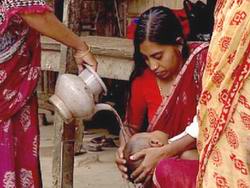 In Bangladesh, where heat ravishes the land, local villagers drink at least twice as much water as in the United States. In the 1970s, an effort was made by aid agencies to provide potable non-surface water. UNICEF dug thousands of wells throughout the country. These wells inadvertently tapped into underground arsenic lines. In what is now considered one of the worst mass poisonings in human history, thousands of people in West Bengal and Bangladesh are suffering from arsenic poisoning from these contaminated water sources. Filmmaker Amirul Arham investigates how and why contamination occurred and documents why it persists today-as government and health organizations continue to fail to intervene.
The national tragedy is seen through the eyes of Rekha, a young contaminated woman abandoned by her husband, and two young girls who were also contaminated. Amirul explores the struggle one village must overcome to treat the disease and rid the tainted water source from their community. THE DEVIL'S WATER taps into the complex world of international aid agencies through the perspective of ill-fated aid recipients. Three years in the making, it is a striking case study of the best of intentions gone awry and the power of even the most impoverished communities to rise up and challenge the global health system that has failed them.
In Bangladesh, where heat ravishes the land, local villagers drink at least twice as much water as in the United States. In the 1970s, an effort was made by aid agencies to provide potable non-surface water. UNICEF dug thousands of wells throughout the country. These wells inadvertently tapped into underground arsenic lines. In what is now considered one of the worst mass poisonings in human history, thousands of people in West Bengal and Bangladesh are suffering from arsenic poisoning from these contaminated water sources. Filmmaker Amirul Arham investigates how and why contamination occurred and documents why it persists today-as government and health organizations continue to fail to intervene.
The national tragedy is seen through the eyes of Rekha, a young contaminated woman abandoned by her husband, and two young girls who were also contaminated. Amirul explores the struggle one village must overcome to treat the disease and rid the tainted water source from their community. THE DEVIL'S WATER taps into the complex world of international aid agencies through the perspective of ill-fated aid recipients. Three years in the making, it is a striking case study of the best of intentions gone awry and the power of even the most impoverished communities to rise up and challenge the global health system that has failed them.
-Nina Gilden Seavey
The French Embassy
9877 Chapman Avenue, Suite D, Garden Grove CA 92841, Hollywood, U S A
October 5th - 14 th, 2006
Le Port - Ille de La Réunion, Ocober 2006
AWARDS :
Arsenic, BBC,
Tuesday 9 May 2006 9:30-9:45 (Radio 4 FM)
Arsenic has been a popular method of poisoning people since the Middle Ages, but there are some life forms which thrive on it. Biologist Ron Oremland has discovered microbes living in lakes in America that use arsenic in the same way that we use oxygen.
It's a discovery that could point the way towards cleaning up parts of the world, such as Bangladesh, where the water supply is heavily contaminated and where thousands of people suffer serious health consequences.
Scientists have identified a special group of bacteria responsible for breaking down arsenic in groundwater.
This was disclosed by a Bangladeshi scientist conducting a study in the UK on the cause of naturally occurring arsenic release into groundwater table.
The discovery may provide a possible solution to groundwater arsenic contamination that now exposes an estimated eight million people in 61 districts in Bangladesh to serious health hazards.
Millions of people, mostly in the rural areas, have developed various symptoms of poisoning from drinking arsenic-contaminated water from tubewells for decades.
The study by Farhana Islam, supervised by other researchers, showed the special group of bacteria 'gains energy by respiring (breathing), using the metal iron and arsenic containing minerals in the earth sediments'.
The young scientist said, "Our results show that these are the special anaerobic bacteria, as they don't need any oxygen to support their growth. They are known as metal-reducing bacteria. We are very interested in iron-reducing bacteria that use iron as their growth substrate, and can also use arsenic when the iron is used up."
The bacteria cause changes in the mineral structure of the sediments, leading to release of arsenic into groundwater, the study says.
Farhana, who studies in the Department of Earth Sciences and Williamson Research Centre for Molecular Environmental Science at the University of Manchester, told The Daily Star, "We are looking at how these processes of breaking down the mineral can be reversed so that the groundwater is safe to drink."
She elaborated, "With our results, we found that maximum amount of arsenic was released from contaminated sediment into groundwater in the absence of oxygen."
There were several hypotheses concerning the release of arsenic into the groundwater systems of West Bengal in India, where the researchers worked. Some suggested a role for aerobic bacteria (arsenopyrite oxidation), some suggested a role for metal-reducing bacteria while others considered the problem to be driven by geochemistry.
The scientists from Manchester University conducted experiments in their laboratory with sediments collected directly from an area of West Bengal affected by arsenic.
"We were the first group to combine geochemical, mineralogical and microbiological/molecular biology techniques to study this system, and have presented the first direct evidence to support a role for metal-reducing bacteria in arsenic release from the sediments. The organisms identified as playing a key role are iron reducing bacteria that can attack arsenic once they have exhausted iron as a growth element," Farhana explained.
Studies showed that this type of bacteria is unable to use oxygen for growth, rather they use different metals to support their metabolism. Metal-reducing bacteria 'breathe' metals such as iron to get energy from their food, in the same way humans breathe oxygen to break down food.
The iron-reducing bacteria use iron through the electron transport system in the anaerobic respiration and gain energy for their growth by reducing this iron. This process is known as dissimilatory iron-reduction.
Explaining the process of arsenic contamination, Farhana said instead of using oxygen, the anaerobic bacteria gain their energy by respiring, (breathing) using iron-containing minerals in the sediments, a process called iron reduction.
By doing this, the bacteria transfer electrons to iron oxide rust coating the sediments, causing changes in the characteristics of the minerals. And when the iron runs out, the bugs start to utilise other metals, such as arsenic, which occurs naturally. The chemistry of the arsenic is changed and the reduced arsenic is able to dissolve into groundwater, she said (Daily Star, August 14, 2004).
Processes conducive to the release and transport of arsenic into aquifers of Bangladesh
Matthew L. Polizzotto*, Charles F. Harvey†, Steve R. Sutton‡, and Scott Fendorf*§ *Department of Geological and Environmental Sciences, Stanford University, Stanford, CA 94305; †Parsons Laboratory, Massachusetts Institute of Technology, Cambridge, MA 02139; and ‡Consortium for Advanced Radiation Sources and Department of Geophysical Sciences, University of Chicago, Chicago, IL 60637
Arsenic is a contaminant in the groundwater of Holocene aquifers
in Bangladesh, where _57 million people drink water with arsenic
levels exceeding the limits set by the World Health Organization.
Although arsenic is native to the sediments, the means by which it
is released to groundwater remains unresolved. Contrary to the
current paradigm, ferric (hydr)oxides appear to dominate the
partitioning of arsenic in the near surface but have a limited impact
at aquifer depths where wells extract groundwater with high
arsenic concentrations.
We present a sequence of evidence that,
taken together, suggest that arsenic may be released in the near
surface and then transported to depth. We establish that
Our analyses thus lead to the premise that arsenic is liberated in surface and near-surface sediments through cyclic redox conditions and is subsequently transported to well depth. Influx of sediment and redox cycling provide a long-term source of arsenic that when liberated in the near surface is only weakly partitioned onto sediments deeper in the profile and is transported through aquifers by groundwater recharge. 21. French researchers may have solution to water-born arsenic
Millions of people in Bangladesh have suffered arsenic poisoning through drinking contaminated water from wells. Dangerously high levels of arsenic are present in other parts of the world too. While developed countries have access to sophisticated water treatments, poorer ones need cheap and sustainable alternatives. Two developments bode well for finding a solution to this lethal problem.
The first piece of good news comes from European researchers whose successful experiments using calcite filters show promising results in reducing arsenic contamination in water. The new discovery by French scientists at the Institut Laue-Langevin (ILL), one of the world's leading facilities in neutron science and technology, could prove to be an inexpensive way of trapping the arsenic.
Tens of millions of people are exposed to dangerous levels of arsenic in their drinking water – up to 50 times the World Health Organisation thresholds – in countries such as India, Bangladesh, Vietnam, Taiwan and Argentina. Even in France, say the team of scientists, many sources of water, including mineral waters, may no longer satisfy new standards introduced in January 2004 – which limit the concentration of arsenic in drinking water to 10 µg L-1.
To decontaminate water supplies, cheap and efficient methods for containing arsenic are needed. ILL research into calcite filters could be the answer. Unlike current solutions, such as manganese sand, iron oxides or ettringite – which although more efficient tend to be rarer and, thus, more expensive – calcite is a very common mineral found in limestone which is ubiquitous.
The team carried out experiments to test the diffusion of arsenic into the bulk of a calcite sample. High-resolution neutron diffraction showed that up to 80mg of arsenic per gram of calcite can be captured by this material – because AsO33- replaces the carbonate (CO32-) in the calcite lattice, which expands to accommodate it. The higher the degree of substitution, the larger the lattice cell becomes, the researchers note.
This discovery is promising because calcite can be synthetically produced in water purification systems simply by allowing a milk of lime – used in water purification plants and power stations to neutralise effluent and separate pollutants – to react with the carbon dioxide in the air. Pure (synthetic) calcite could then be produced cheaply, and provide a simple solution for filtering water contaminated with arsenic.
Million-dollar challenge
In a related development, the US National Academy of Engineering has issued a million-dollar challenge to scientists worldwide: design or create a workable, sustainable, efficient point-of-use water treatment system for arsenic-contaminated groundwater in Bangladesh, India, Nepal, and other developing countries.Individuals or organisations that come up with a cheap and sustainable way of removing the arsenic could qualify to win the Grainger Challenge Prize for Sustainability, which was set up by the academy this year to speed up the development of socially and environmentally sustainable technologies. According to the Grainger Challenge Prize website, the winning system must "be technically robust, reliable, maintainable, socially acceptable and affordable”. Over the coming months the public are being asked to contribute to the competition's design. Detailed criteria for participating in the challenge will be made public in June 2005. Applicants will then have until June 2006 to submit their ideas, and the prize of around €770 000 will be awarded in February 2007 (European commission Research,28 February 2005). 22. Arsenic risk high in Sumatra, Myanmar, Cambodia
Eastern Sumatra, the Irrawaddy delta in Myanmar and Cambodia's Tonle Sap lake are among areas in Southeast Asia facing a high risk of arsenic contamination in the water, according to a study published on Friday.
The researchers use innovative digitalised techniques, drawing on geology, geography and soil chemistry, to compile a "probability map" of naturally-occurring arsenic concentrations in five Southeast Asian countries and Bangladesh.
The map is intended as a useful pointer for health watchdogs, urban planners and water engineers worried about concentrations of this poison in groundwater supplies but lacking the funds to carry out wide-scale analysis of water samples.
Published online in the journal Nature Neuroscience, the Swiss-led study combined several methods to compile its probability model.
These included knowledge about sediments whose textures and chemical or bacterial properties could release arsenic from the local ore, thus contaminating aquifers.
Also factored in were areas with flat, low-lying topography. Arsenic contamination is rarely found in places with slopes.
The benchmark for risk was the World Health Organisation (WHO) guideline of 0.01 milligrams of arsenic per litre in drinking water.
The study predicted that in Bangladesh -- which has the worst arsenic contamination in the world -- the risk of water breaching this guideline was highest in the south-centre of the country and in the northeastern Sylhet basin.
This prediction concurred with water samples previously taken and analysed from tube wells in Bangladesh.
High probabilities of arsenic contamination were also seen for the deltas of the Irrawaddy in Myanmar and the Red River in Bangladesh, for the Chao Praya basin in central Thailand and for the organic-rich sediments of the flood plain of Cambodia's Tonle Sap lake.
The computer model said an area of about 100,000 square kilometres (38,600 square miles) on the east coast of Indonesia's main island, Sumatra, was likewise "prone to high risk" of contamination above the WHO benchmark.
This prediction was then borne out by samples taken from a zone in Sumatra deemed to have high-risk and low-risk aquifers.
However, many wells in this area are deep and draw water from below the water-bearing sediments which have the arsenic problem, the study says.
"The prediction map is a useful tool for identification of areas at risk of arsenic contamination, but... understanding the local geology as a function of depth is of vital importance for specific areas," it cautions.
In Bangladesh, tens of millions of people are potentially exposed to arsenic-tainted water, boosting the danger of skin lesions, respiratory illness and cancer.
The risk comes from so-called shallow tube wells which were drilled in the 1970s and 1980s, ironically in a bid to provide rural Bangladeshis with safe water. Millions of these pipes were installed.
The new study is lead-authored by Michael Berg of the Swiss Federal Institute of Aquatic Science and Technology in Duebendorf (Afp, Paris, 2008-07-13
).
With widespread arsenic found in the groundwater in Bangladesh the people of this country have lost their rights to safe drinking water and therefore their right to life. The spread of this poison did not occur on one sudden day but over a period of decades. This water was provided without quality control and without meeting standard drinking water protocols. In fact, until recently Bangladesh did not have a proper ground water policy of its own nor it did follow any of the existing international policies or protocols prevalent in other countries. The arsenic crisis in Bangladesh is a classical example of negligence and distorted development policies.
State liability under constitutional law
Under the Bangladeshi Constitution, every citizen is entitled to the fundamental right to life. Therefore, drinking poisoned water that damages the body until the quality of life is negligible, or until the person dies, does not fulfill the right to life as envisaged by the constitution. Simply put, the right to life becomes fictional without access to safe drinking water. Article 18 emphasizes the responsibility upon Govt. for ensuring public health. Bangladesh has also ratified the United Nations Convention on the Rights of the Child that obligates its signatories to ensure the health of each child by combating 'disease and malnutrition. The Bangladeshi government therefore has a constitutional and international legal obligation to ensure that all its citizens have access to safe drinking water.State liability under environmental law
There is a substantial body of environmental law that regulates state activity in relation to the provision of safe drinking water. To date, a writ application has been applied for to prevent the government and its agencies from installing further tube wells around the country in adherence to various environmental laws, of which the most relevant are discussed below. The Petitioners of this writ are awaiting a court hearing wherein for arguing as to the liability of the Ministry of Health and Family Welfare (MOHFW) and the Ministry of Local Government, Rural Development and Co-operatives.The MOHFW and MOLGRD are responsible via their departments for matters relating to public health and, standardization of and quality control of water. The Pouroshova Ordinance 1977 gives a pouroshova the responsibility of providing water, and promoting the public health (Sub-section 70, 73 and 74). This certainly has interesting ramifications for claims in negligence by arsenicosis patients, as per the section below. The first schedule of the Local Government (Union Porishod) Ordinance 1983 prohibits tube wells that are dangerous (clause 18), and charges the state with the positive duty of ensuring that this is done.
The Groundwater Management Ordinance 1985 requires local authorities to grant licenses before tube wells can be sunk. It is almost certain that very few, if any, Upazillas comply with this legislation.
Culpability and accountability: legal campaigns
The involvement of government, non-government and multinational agencies has had a significant role in this problem, unwittingly or otherwise. The position of the petitioner has always been that the water providing agencies must be accountable for their actions in failing to monitor the water quality of groundwater where they have responsibility for having installed tube wells. International law is in accord with this sentiment: the polluter must pay.To date, three separate actions have been taken as an attempt to begin to redress some aspects of this problem through the law courts.
Advocate Rabia Bhuiyan applied to the High Court for a writ to declare that the government show cause as to why they should not halt the installation of shallow and deep tube wells all over the country when they were fully cognizant of the problem of arsenic contaminated groundwater. Her suit was dismissed on the grounds that she had been unable, on that occasion, to show any provisions of law that compelled the government to satisfy her demand. F
ollowing this action, Brotee instructed a barrister to make a similar application to the High Court, with the relevant provisions of law. This application was successful and the High Court declared in July 2001 that the government should show cause as to why it should not immediately halt their tube well installation programme. The Petitioners are currently awaiting a hearing date before the Supreme Court. The third case, which is the main concern of this paper, is a public litigation against a multinational called the British Geological Survey (BGS). Brotee, in conjunction with the Bangladesh International Action Network (BIAN) has instructed Alexander Harris, an English law firm, to represent two arsenicosis patients in a claim for damages against the British government department in charge of the British Geological Survey (BGS). BGS conducted a survey of the groundwater in Bangladesh in 1992 but did not test for arsenic. Alexander Harris together with Leigh Day and co., two British firms have jointly undertaken the case against the BGS on behalf of the arsenic victims in the English High Court.
The accountability of a multinational: Taking the BGS to the British Court
The historical basis of the claim: In 1970, the Government undertook a programme of tube well drilling in order to provide an alternative source of drinking water in Bangladesh. The BGS began working in Bangladesh in 1983 to help install deep tube wells. The BGS then became involved in a separate study, the objectives of which included, "Produce maps of ground water environments and indicate possible conditions where trace elements studied may interact with other factors to produce factors toxic to elements of the biological environments including man".The Claimant's case:
The Petitioner alleged that the work carried out by the BGS in compiling their 1992 Report was conducted carelessly as insufficient tests were carried out to assess the water supply for its fitness for human consumption. It argued that the report itself was written in a way, which leave the reader to assume that the water was fit for human consumption. The water in Bangladesh contained arsenic and as arsenic was not tested for, it remained unidentified and the Claimants have suffered injury as a result of drinking water.The Claimants also argued that the Defendants knew that arsenic is present in drinking water, is dangerous to humans and indeed they tested for arsenic in Britain in 1989. Moreover, the BGS would have known, or should have known, that there was a possibility that arsenic would be presented in the drinking water in Bangladesh as it had been identified in parts of India before 1992. It also argued that BGS knew the survey was intended to be for the use and benefit of the Bangladeshi Government and the agencies involved in the management of the country's water resources.
The claimants case is that the Defendants (BGS) aught to have tested the fitness for human consumption of the water supply when undertaking the survey upon which the 1992 BGS Report was based and it also aught to have made it clear to any reader that it could not be relied on for that purpose.
The obligations and duty of care of the defendants arises from the following facts:
After hearing, the Judge considered the arguments put forward by both sides for around 4 weeks before giving his Judgement. He concluded that this was a case that should progress to full trial. This was no small victory. It at least meant that so far the Defendants failed in their attempt to prevent us from taking the case to full trial.
The Defendants next applied to the Court for leave to appeal this decision. The trial judge refused them leave. After that the Court of Appeal with Lord Justice Kennedy arrived at a split decision, that BGS was neither responsible for the hazard nor for providing potable water. It also had no control over who saw the report or how it was used.
While this is a disappointing decision the legal team feels that this as 'losing the battle but not the war'. The case is now pending before the House of Lords - the highest court in Britain. The Law Lords adjudicate only on points of law. The Claimants are now seeking leave for appeal to the House of Lords. This case presents a novel point of law on the duty of care. The Court of Appeal held that the BGS owed no duty of care to our clients because there was no "proximity". It is a point that has not been looked at before and so cannot be decided by similar precedent cases because there aren't any. If there are no precedent cases or there is no common law on the point- and the Law Lords therefore need to decide what the law is to be. This is the first case where a claim raises issues of direct versus indirect injury; personal injury versus economic loss and the nature of the duty owed in aid projects to the developing world (Sharmeen Murshid,Daily star, September 26, 2004).
Last Modified: July 27, 2008